CouponF5 is an independent publisher. We may earn a commission when you purchase through our links, at no extra cost to you. Merchant terms apply.
In this guide
A coupon is not actually a good deal when it makes you spend more than you intended, offers savings against an unrealistic price, or leaves you with a higher total after fees and other conditions. A valid promotion can still be a poor buying decision. The important comparison is what you would pay for the purchase you truly needed, not what the coupon banner says you “saved.”
These eight warning signs help you recognize when a discount should be skipped—even if the code is real and the checkout accepts it.
1. The Coupon Makes You Buy Things You Did Not Need
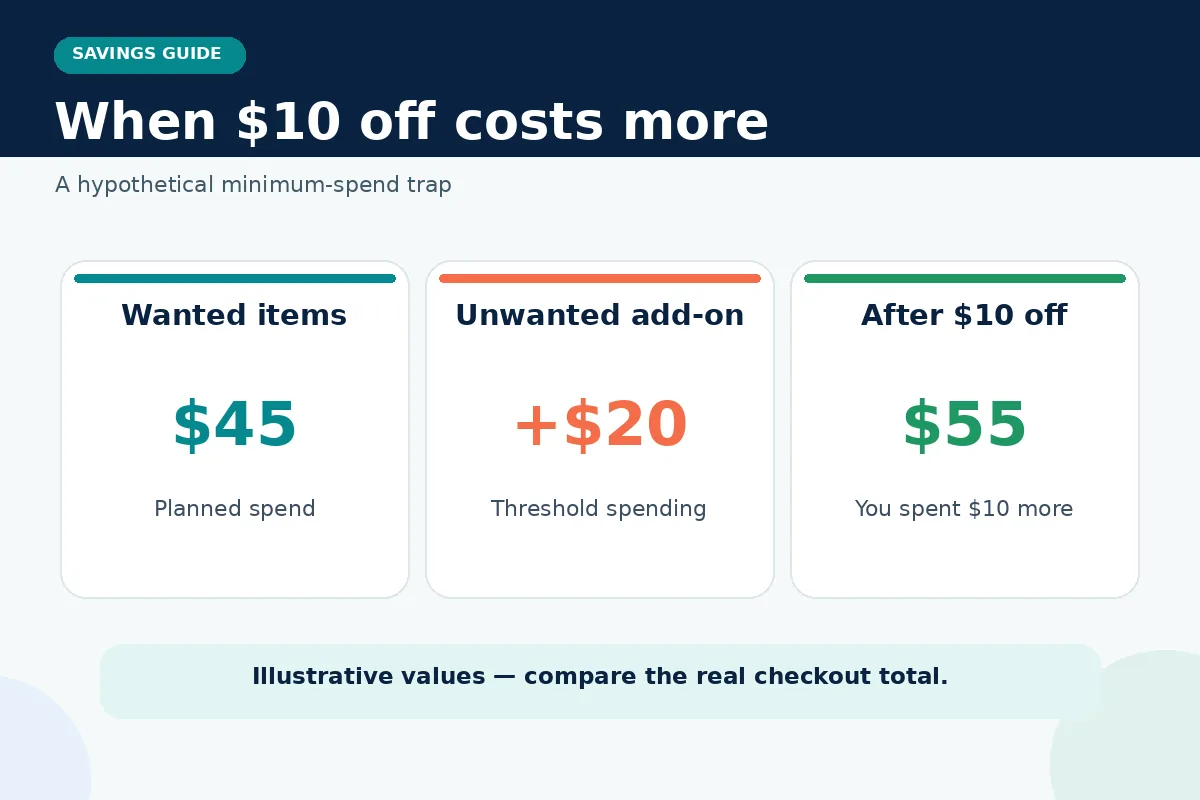
The biggest trap is a discount that changes the size of your basket. Suppose you planned to spend $45. A hypothetical $10-off code requires $60 of qualifying merchandise, so you add a $20 item you did not want. Your merchandise subtotal becomes $65 and then $55 after the discount. You are now spending $10 more than the original $45 plan before any changes in delivery or tax.
The coupon itself was applied successfully, but it did not save money on your planned purchase. If you genuinely need the extra product and would soon buy it anyway, the calculation may be different. The key is not counting an unwanted add-on as a financial win.
2. The Advertised “Before” Price Is Not a Useful Comparison
A seller may advertise a dramatic percentage reduction from a reference price. Before treating the difference as your savings, compare the actual selling price with recent prices for the same product at credible stores. An inflated or irrelevant reference price can make an ordinary price look extraordinary.
For example, an illustrative product shown as “$120, now $90 with coupon” is not necessarily a bargain if a reputable competitor sells the same model for $78 with comparable delivery and return terms. These amounts are hypothetical; no specific merchant is being accused of misleading pricing.
Focus on the lowest credible total you can actually pay for the identical item, rather than assuming the advertised “original price” is proof of value. The FTC recommends comparison shopping and checking total costs and seller reputations.
3. Shipping or Other Fees Erase the Discount
A coupon might remove $8 from the item subtotal while the seller charges $12 more for delivery than a competing store. That can negate the apparent savings. Compare the real payable total, including shipping, handling, taxes and any required extras.
Be careful about assuming free shipping includes expedited delivery, oversized items or remote destinations. Read the merchant’s shipping terms for the exact address and service you need. If different sites offer different delivery speeds, make that difference explicit in your decision.
4. A Better Promotion Is Already Applied
Some websites automatically discount selected products. Entering a coupon may not stack with that discount, or the checkout may select a different eligible combination. A code that sounds impressive might replace a stronger offer or be rejected.
Shopify’s discount-combination documentation describes merchant-configured rules for mixing product, order and shipping discounts. That is one platform’s approach, not a universal guarantee.
When deciding whether to use a code, compare the full order total with the existing promotion and with the alternative. There is no benefit in applying a coupon just for the sake of using one.
5. The Coupon Applies to Much Less Than You Think
A banner may emphasize a large percentage, but only certain items, variants or collections qualify. If just one $25 item in a $100 cart is eligible for 20% off, the item-level savings are $5—not $20. Restrictions may also include maximum savings, minimum eligible spending or new-customer requirements.
A valid code may therefore be technically correct while offering only a small benefit on your specific order. Check the discount lines rather than multiplying by the full cart without reading the terms.
6. The Discount Comes With an Unwanted Subscription or Membership
A first-order discount can be useful if you genuinely want a recurring delivery service or paid membership. But it may not be a good deal if it commits you to further payments you did not plan for. Review recurring charges, renewal dates, cancellation conditions and whether the introductory price covers only the first shipment or billing period.
Do not treat a low initial charge as the full cost of a long-term purchase. If you only want one item, compare the one-time purchase price with the complete subscription obligation before agreeing to anything.
7. Return Rules Make the “Savings” Riskier
Clearance and promotion orders can have different return terms. If a product may not fit, check whether you can return it, the time window and who pays for return shipping. Restocking charges or nonrefundable delivery fees may be material for expensive or size-sensitive purchases.
A nominal discount is less compelling when an uncertain product is difficult to return. The FTC’s online-shopping guidance encourages consumers to read shipping, refund and return policies before buying.
8. The Seller or Coupon Source Is Not Trustworthy
An implausibly large discount from an unfamiliar seller deserves independent verification. Check the full merchant domain, product details, reviews from several sources, accepted payment methods, and clear contact and return information. A coupon directory’s “working” label does not prove the linked store is genuine or that the promotion is current.
Be wary of a page asking for your retailer password, one-time security code, payment details to unlock an alleged free coupon, or an unfamiliar software download. If the destination seems suspicious, leave it and navigate to the merchant’s verified site on your own. No coupon is worth unnecessary exposure of sensitive information.
How to Know When to Skip an Offer
A quick decision framework is more reliable than the percentage in a banner. Ask three questions:
- Would I buy the same product at a sensible price without this coupon? If not, the discount may be creating demand rather than reducing cost.
- Is the post-coupon price genuinely competitive? Compare the same item, seller credibility, delivery and relevant return conditions.
- Is the complete payable amount lower without unwanted obligations? Include tax, delivery, handling, membership costs and any additional merchandise you had to purchase.
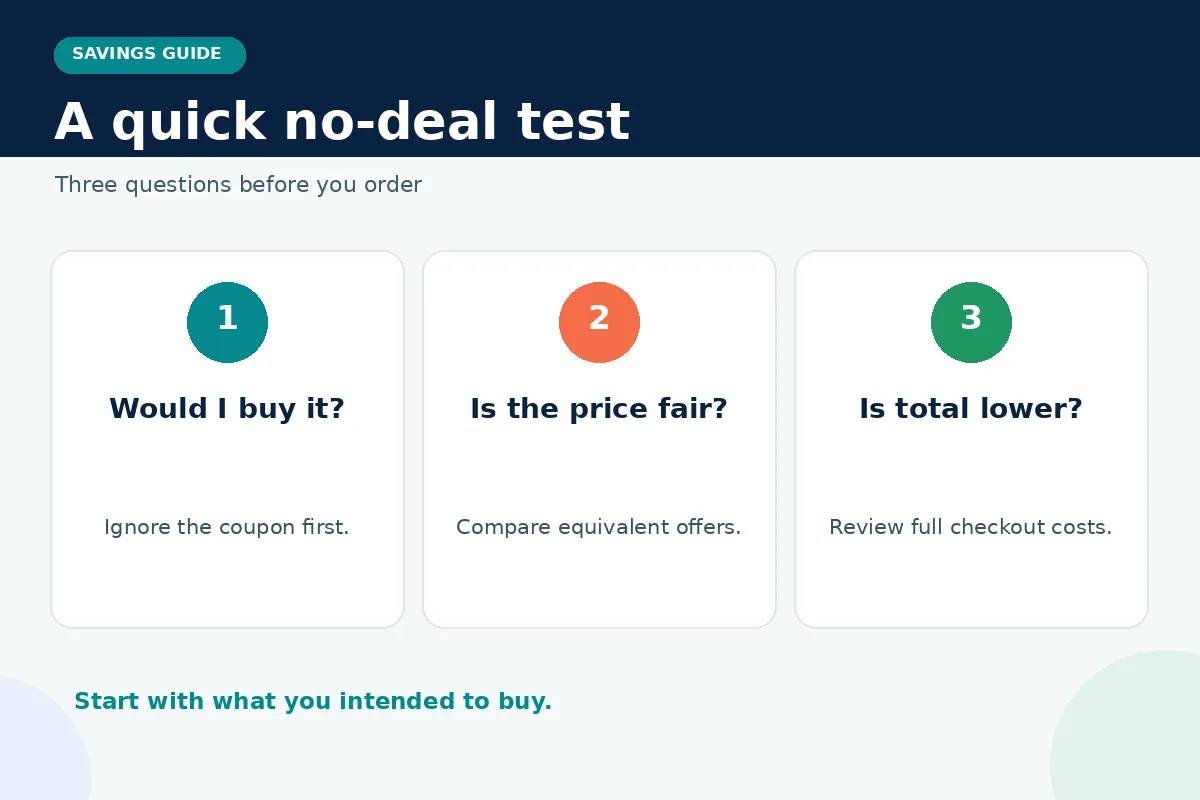
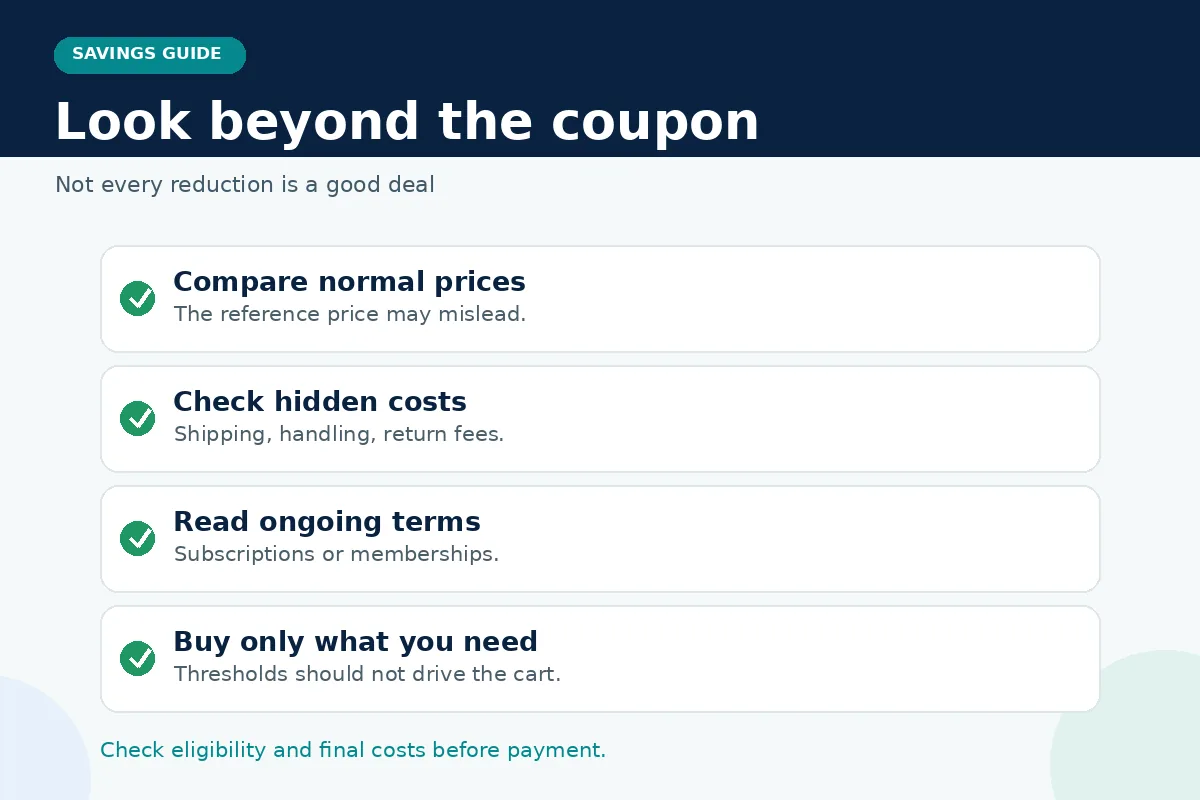
If any answer is clearly no, skipping the coupon may be the better financial choice. You are not losing savings by refusing an unneeded purchase.
Coupon Savings vs. Avoided Spending
Saving $20 on a planned $100 purchase can leave you $20 better off, assuming all else is equal. But spending $80 on an unplanned item because it was “20% off” still means $80 left your budget. The two decisions should not be treated as identical.
The useful benchmark is not always the merchant’s list price; it is what a rational shopper would have spent for a suitable alternative. Establish that benchmark before reading the promotion.
Frequently Asked Questions
Can a real coupon still be a bad deal?
Yes. It can increase spending through unwanted add-ons, replace a better promotion or apply to an overpriced product.
Is a big percentage discount always better?
No. Exclusions, caps and an inflated reference price can make the actual benefit much smaller than the headline suggests.
Is free shipping worth spending more to qualify?
Only when the additional merchandise is something you genuinely want and the combined order remains worthwhile. Buying unwanted items to waive delivery can cost more.
Should I trust coupon-site “verified” labels?
Use them as leads, not guarantees. Verify the offer and the seller independently at the real checkout.
What if my coupon only applies to one item?
Calculate savings on that eligible item and compare the complete order total. Do not apply the advertised percentage to excluded products.
The Bottom Line
A coupon is a good deal only when it makes a sensible planned purchase cheaper under terms you are comfortable accepting. Compare real prices, full checkout costs and future obligations. Sometimes the smartest coupon decision is not to use it at all.