CouponF5 is an independent publisher. We may earn a commission when you purchase through our links, at no extra cost to you. Merchant terms apply.
In this guide
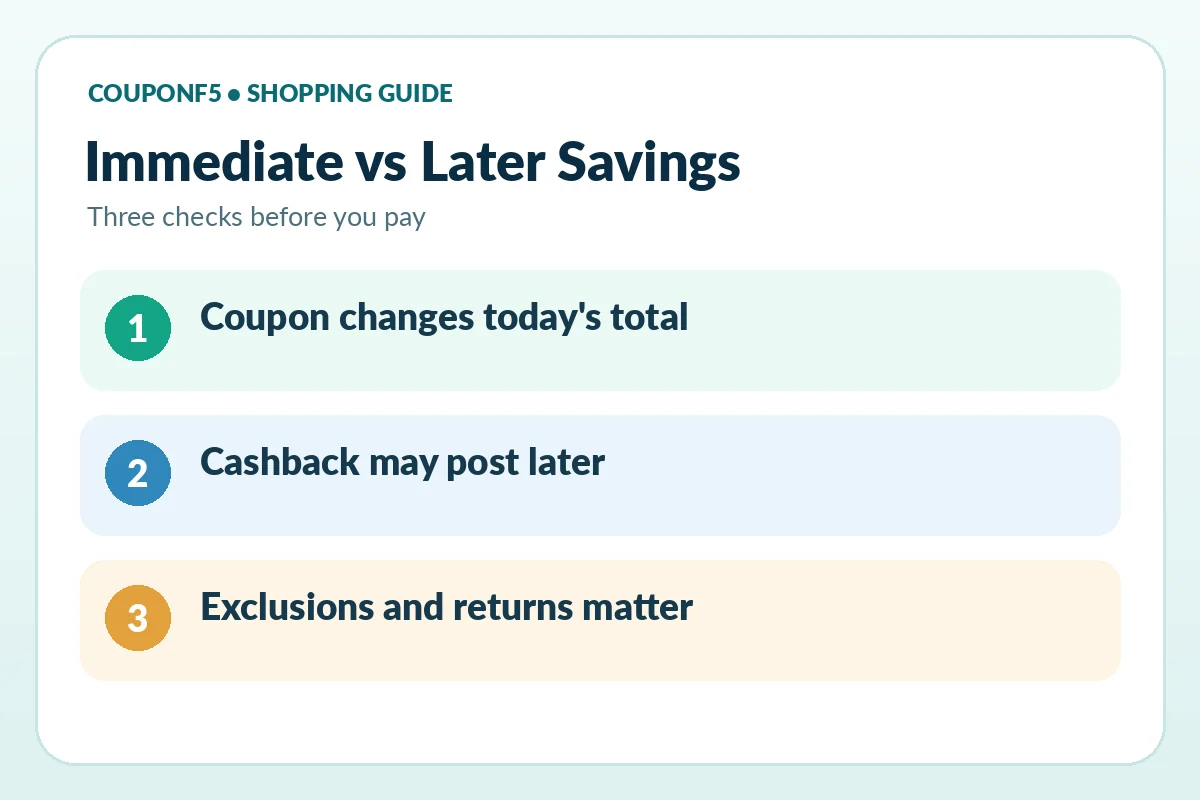
A coupon code saves more when its immediate eligible discount exceeds the cashback you can actually earn and redeem; cashback wins when the final eligible reward is worth more. The main difference is timing: a coupon normally lowers today’s checkout bill, while cashback may be credited later under separate program rules.
To compare fairly, use the same planned item, seller, shipping method and eligible purchase amount. Do not assume every cashback percentage applies to the full order or that a coupon and a reward can be combined.
Coupon Codes and Cashback Work Differently
A coupon is generally a retailer-issued promotion that reduces a qualifying product subtotal, order amount or shipping charge at checkout. Cashback is a reward arrangement that may come from a merchant, a shopping portal or a card issuer, depending on the program. It can arrive as a statement credit, deposit, points converted to cash or another eligible benefit.
These are not interchangeable payment events. A coupon is visible as a deduction before payment, while a cashback claim may remain pending until a purchase settles, a return period passes or the account reaches a redemption requirement. Read the specific reward terms.
Example: 10% Off vs 12% Cashback
Imagine an eligible $100 purchase before separate shipping and tax. A hypothetical 10% coupon reduces the immediate merchandise amount to $90. A hypothetical 12% cashback offer on the original $100 eligible base would nominally return $12 later, making the net eligible merchandise cost $88 if the reward is successfully tracked, paid and redeemed.
In that simplified example, cashback has a $2 higher nominal benefit. But you still pay the $100 merchandise amount initially and may have to wait for the $12. If the cashback is not eligible, is rejected or never redeemed, the immediate coupon is worth more. These are examples, not current offers.
Calculate the Real Eligible Base
A cashback rate might exclude tax, shipping, certain product categories, gift cards, marketplace sellers or amounts paid by particular methods. A percentage coupon may have product exclusions or a maximum savings cap. Calculate each from the base specified in its terms rather than from the full amount shown in your cart.
If a 10% discount applies only to a $40 eligible item within a $100 cart, it saves $4, not $10. A cashback reward on a different qualifying amount can produce yet another result. The right comparison starts by identifying what each offer actually covers.
Pay Attention to When Cashback Is Available
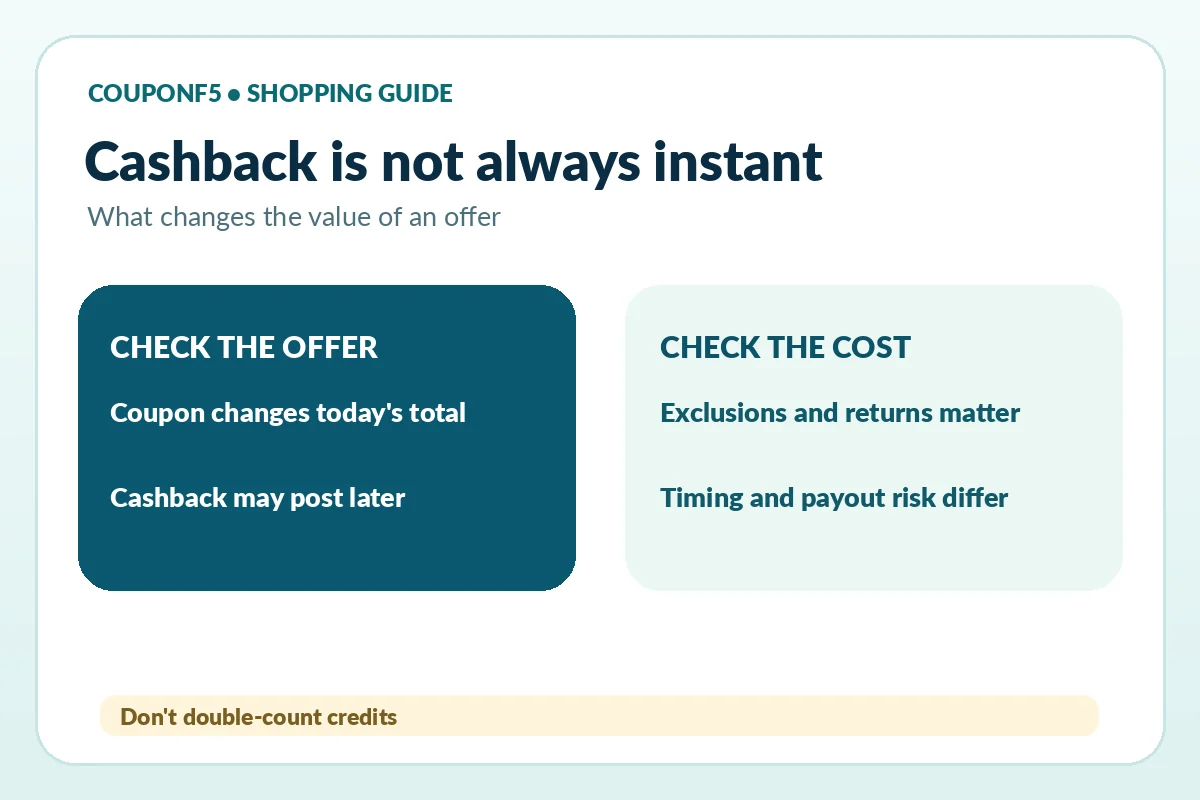
Not all cashback is immediate. A program might wait for an order to be confirmed, reject purchases that are returned, or apply a payout threshold. A reward shown as “pending” is not the same as money you can spend today.
The Consumer Financial Protection Bureau’s guidance on credit-card rewards discusses the importance of clear redemption terms and the possibility that program practices can interfere with promised rewards. That document concerns covered rewards programs; it does not establish the rules for every shopping cashback website.
Can a Coupon and Cashback Work Together?
Sometimes, depending on both the merchant and reward provider. One program may allow a code and still award cashback, while another may exclude unlisted promo codes or calculate cashback on the discounted amount. A card reward can also have distinct rules from a shopping portal.
For a hypothetical eligible $100 cart reduced to $90 by a $10 coupon, a separate 12% cashback program calculated on the remaining $90 would yield $10.80 later. The combined nominal benefit would be $20.80 if both actually qualify. It would be wrong to calculate cashback on $100 without checking the program’s base, or to assume both benefits always stack.
Returns and Cancellations Can Change Cashback
Returning merchandise may also reverse or reduce an earned reward. Some programs wait for the return period to pass before paying, and a partial return can change the eligible purchase amount. Read what happens if the retailer cancels, changes or refunds the transaction.
A coupon generally changes the purchase price immediately, though the merchant’s refund calculation may reflect the discounted amount rather than a higher list price. Keep the final receipt and reward terms if you need to resolve a discrepancy.
Compare Cash Outlay, Net Value and Certainty
Consider three dimensions: what you must pay now, what you can realistically receive later, and how much uncertainty the reward carries. A $10 immediate deduction is a known reduction once checkout confirms it. A claimed $12 reward may be more valuable in nominal dollars but has different timing and conditions.
For budget-sensitive purchases, today’s cash outlay can matter. If you cannot comfortably pay the full price while waiting for a reward, do not treat cashback as an automatic financing solution.
What About Credit-Card Cashback?
Card rewards are separate from retailer coupons and shopping portals. They may be based on eligible transactions, category definitions or cardholder terms, and receiving a reward does not eliminate any interest or fees from borrowing. If you carry a balance, finance costs could be much larger than the coupon or cashback value.
Use card rewards only as an additional comparison after verifying that the overall purchase is affordable. This article is about shopping decisions, not a recommendation to open a new credit account.
A Four-Step Coupon-versus-Cashback Test
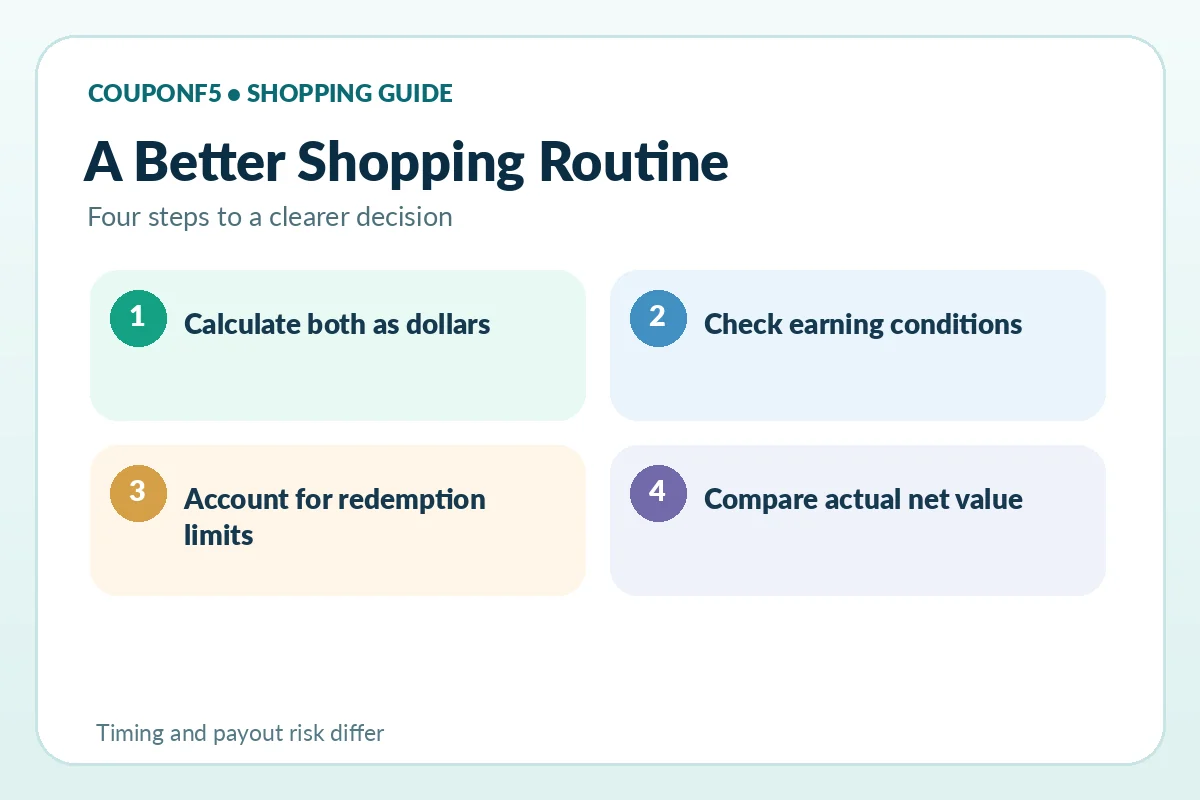
- Verify the same product, seller and all-in checkout cost.
- Calculate the coupon reduction on actually eligible items.
- Calculate the conditional cashback on its permitted base, considering payout timing and limits.
- Compare the actual immediate payment and reliable net value, then confirm whether stacking is allowed.
Frequently Asked Questions
Does cashback lower the amount due at checkout?
Not necessarily. Many programs credit rewards later, although some store benefits are applied immediately. Check the program.
Can I use a coupon with cashback?
Sometimes. Coupon exclusions and reward tracking rules may limit or change the combined benefit.
Is 15% cashback better than a $10 code?
It depends on the eligible purchase base, whether the reward is actually paid, and any discount restrictions.
Do returns affect cashback?
They can. Many rewards are contingent on completed eligible purchases and may be reversed after refunds.
The Bottom Line
Compare the immediate checkout reduction with the cashback you can realistically redeem later. Reward timing, eligibility and certainty matter as much as the headline percentage.