CouponF5 is an independent publisher. We may earn a commission when you purchase through our links, at no extra cost to you. Merchant terms apply.

In this guide
The best coupon for your purchase is the one that makes your actual, eligible order cheapest—not the one advertising the biggest percentage. Compare the dollar value of each offer on the same planned cart, check its restrictions, and look at the final total after shipping and other charges. A coupon that requires an unwanted purchase or replaces a better promotion may not be your best choice.
This guide gives you a repeatable way to choose among percentage-off codes, fixed-dollar discounts, free-shipping offers, and other promotions without relying on untested coupons or generic “best deal” claims.
Start With the Purchase You Already Intended to Make
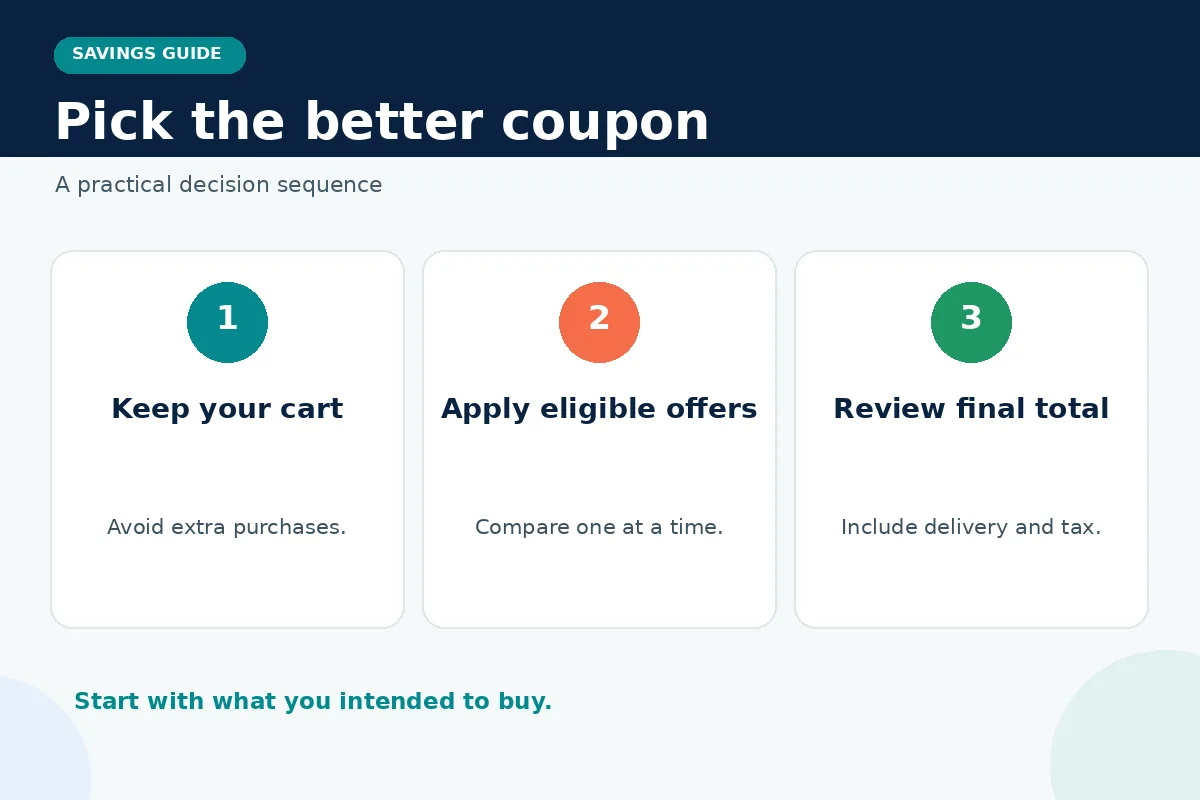
Before searching for discounts, choose the item, size, quantity, and delivery method that fit your needs. Record the regular checkout amount. This matters because a coupon can tempt you to add unnecessary products just to qualify for a minimum spend. If you change your cart to chase an offer, you no longer have a fair comparison.
Also decide which seller you trust and whether the product has the right return conditions. A slightly lower total from an unfamiliar retailer can be less appealing if its delivery, warranty, or return terms are substantially worse. The FTC’s online shopping guidance recommends comparing total costs, including delivery, taxes, and fees, rather than looking only at advertised prices.
Step 1: Identify What Each Coupon Actually Does
Read the benefit, not only its promotional label. Common options include a percentage reduction on eligible items, a fixed-dollar deduction, a discount on selected products, a shipping waiver, and a buy-X-get-Y reward. A coupon code and an automatic discount can also produce the same type of benefit; the difference is how the offer gets activated.
| Offer | How to value it | Typical restriction to check |
|---|---|---|
| Percentage off | Eligible subtotal multiplied by the discount rate | Excluded items and savings cap |
| Fixed amount off | Stated dollar reduction if the order qualifies | Minimum qualifying spend |
| Free shipping | Shipping fee that would otherwise be charged | Destination, delivery method, threshold |
| Buy X get Y | Value of the eligible additional item or its reduction | Required quantities and product selection |
Retailers control these conditions. For example, Shopify distinguishes amount-off, shipping and buy-X-get-Y discount types. That is a platform capability, not evidence that any particular retailer currently offers all of them.
Step 2: Calculate the Value on Your Specific Cart
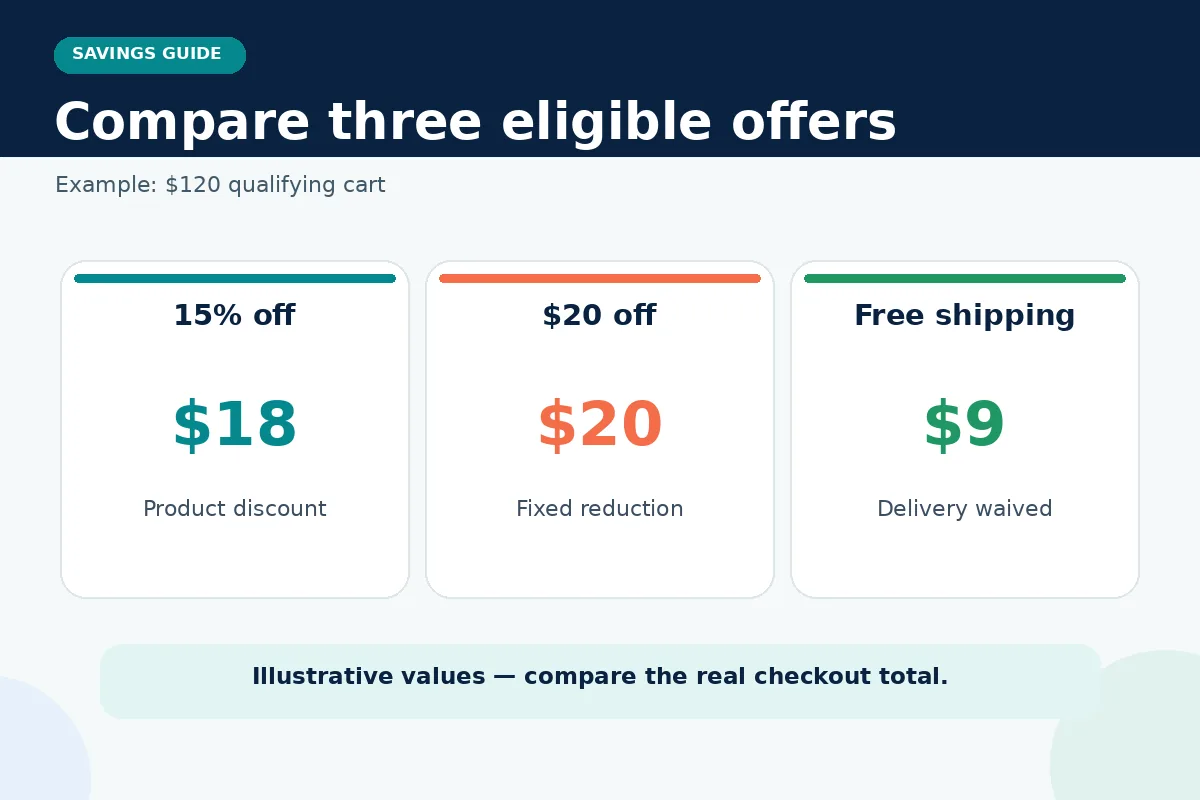
Suppose your cart contains $120 of eligible merchandise and the regular delivery charge is $9. You have three entirely hypothetical, mutually exclusive offers: 15% off eligible merchandise, $20 off the order, or free shipping. The percentage offer saves $18, the fixed offer saves $20, and free shipping saves $9. If all restrictions are otherwise equal, the $20 deduction is worth the most.
These are illustrative amounts, not functioning coupon codes. The calculation changes when a percentage applies to only one item, a discount is capped, the fixed coupon has a minimum, or shipping is already free. Compare the same items and delivery service each time.
Step 3: Check Eligibility Before Declaring a Winner
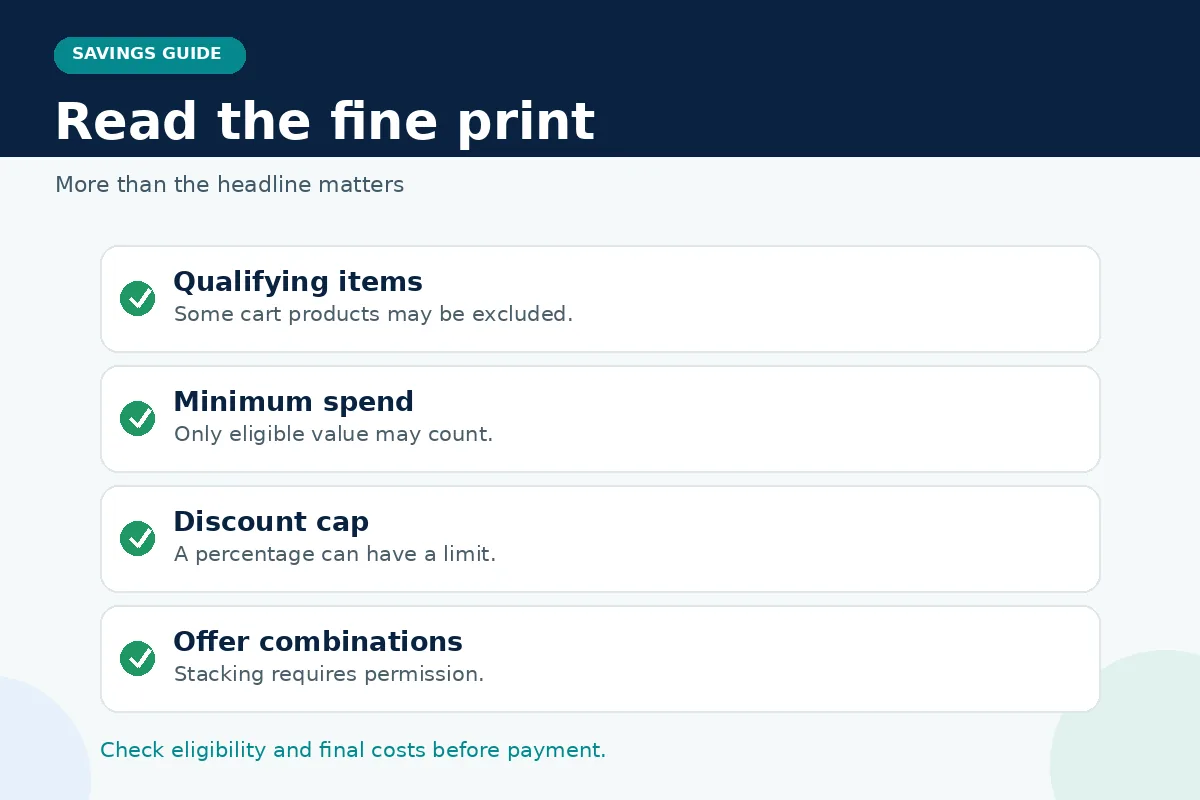
A $20 coupon is not useful if it requires $150 in eligible spending while your planned cart is $120. A 20% banner might be less valuable than a 10% code if most of your products are excluded. Before calculating savings, verify:
- Dates: is the promotion active at the retailer’s checkout time?
- Eligible products: do the exact items, variations or collections qualify?
- Minimum spend: does the qualifying subtotal—not necessarily your entire order—meet the threshold?
- Maximum savings: is there a cap on a percentage discount?
- Customer limitations: is it new-customer-only, member-only, or linked to an account?
- Combination rules: does another code or automatic sale prevent the intended promotion?
Never pay for an item you do not need just to move the eligible subtotal above a threshold unless the additional item has value to you independent of the coupon.
Step 4: Compare the Full Payable Total
A discount on items and a waiver of delivery charges affect different parts of the bill. Check the order subtotal, shipping and handling, taxes, optional additions, and final payment amount with each eligible offer. If tax recalculates after a discount, use the actual checkout amount rather than assuming it stays constant.
For a simple comparison, note the total without the offer, test a legitimate candidate, and record the revised total before payment. Try other codes only when allowed, then keep the lower final amount. If the merchant allows combination of eligible discounts, compare the combined checkout result too.
Step 5: Consider the Real Cost of the Decision
Coupon value is not merely a subtraction problem. Consider whether a promotion changes your purchase in a way you would regret. A free gift may be pleasant, but it does not necessarily reduce how much money leaves your account. A required subscription or loyalty membership may impose ongoing obligations that exceed the first-order discount.
When comparing multiple retailers, make sure you evaluate equivalent products and realistic delivery choices. An item that costs a little more but arrives when needed and can be returned easily might be the better purchase overall. Avoid using the word “best” to mean only “largest nominal discount.”
A Fast Coupon-Selection Decision Tree
- Would you buy these exact items without the coupon? If not, reconsider the purchase.
- Does each offer come from a credible source, and does your cart qualify?
- What is the real dollar benefit for the products or shipping affected?
- Does a different offer or permitted combination reduce the final amount further?
- Does the chosen order still meet your budget and return or delivery needs?
Common Mistakes When Choosing a Coupon
Comparing percentages alone: 20% off a small eligible subtotal may be worth less than a modest fixed-dollar deduction. Ignoring an existing sale: entering another code may remove an automatic promotion or fail to combine. Assuming the whole cart qualifies: excluded items can shrink the savings base. Overlooking delivery: a free-shipping offer may beat a small product discount. Adding unwanted products: a larger cart can turn apparent savings into higher spending.
If a code fails, reread the terms before assuming it is expired or fraudulent. Codes can be valid but ineligible for your basket or customer account.
Frequently Asked Questions
Should I always choose the highest percentage?
No. Translate every eligible offer into dollars and compare the final checkout total after delivery and other charges.
How do I choose between $15 off and free shipping?
Compare $15 with the delivery fee actually waived, accounting for eligibility and any changes to other promotions. If delivery would cost $9, the fixed discount is normally larger before other differences.
Can I use two coupons to get a better result?
Only if the merchant permits that combination and both apply. The presence of two valid codes does not guarantee stacking.
Is a minimum-spend coupon always bad?
No. It can help if your planned order already qualifies. Buying unnecessary items only to meet the threshold can erase the benefit.
Is an automatically applied sale better than a coupon code?
Neither method is inherently better. Keep the eligible discount or permitted combination that produces the lower final total.
The Bottom Line
Choose a coupon by verified checkout value, not marketing language. Start with the items you need, screen the terms, calculate each eligible benefit, and compare final totals on equivalent orders. The best coupon helps you spend less without changing your purchase priorities.