CouponF5 is an independent publisher. We may earn a commission when you purchase through our links, at no extra cost to you. Merchant terms apply.
In this guide
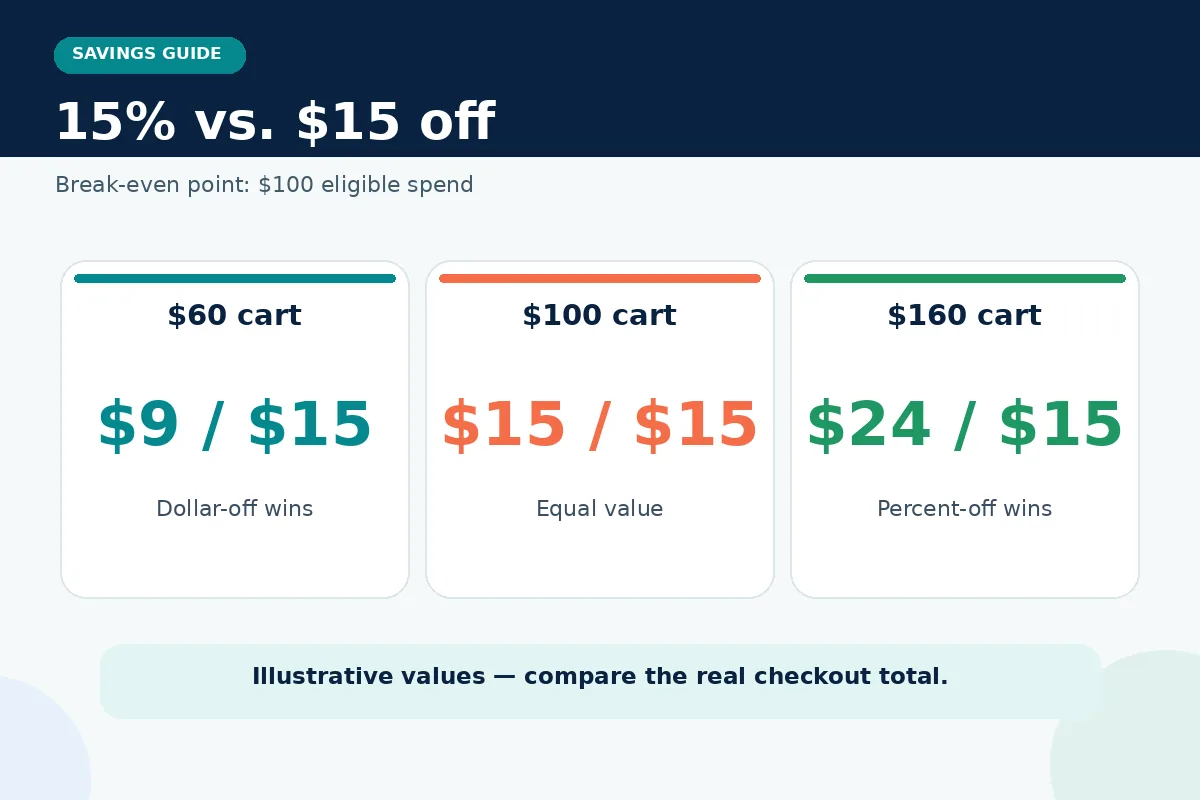
Percentage-off coupons save more on sufficiently large eligible purchases, while fixed-dollar coupons can be better for smaller qualifying carts. The break-even point is easy to calculate: divide the fixed discount by the percentage rate written as a decimal. For example, 15% off and $15 off are equal on a $100 eligible subtotal, assuming both apply without caps or other restrictions.
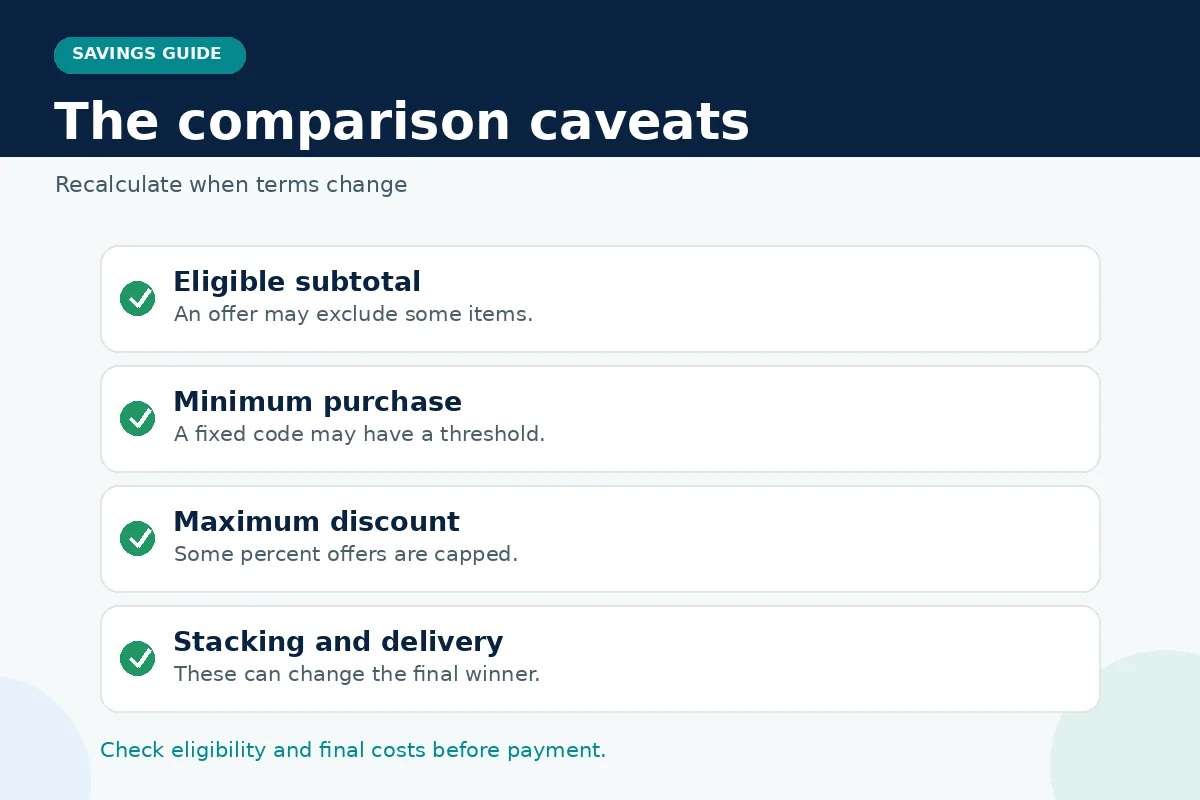
That comparison is about the eligible subtotal—not automatically the entire cart. Minimum purchase requirements, excluded merchandise, maximum discounts and competing offers can change which coupon really wins at checkout.
How Percentage-Off Discounts Work
A percentage coupon removes a share of qualifying item prices or the qualifying order subtotal. The arithmetic is eligible subtotal × percentage rate = savings. For an illustrative $80 eligible subtotal and a 20% coupon, the reduction is $16 and the discounted subtotal is $64 before separate charges.
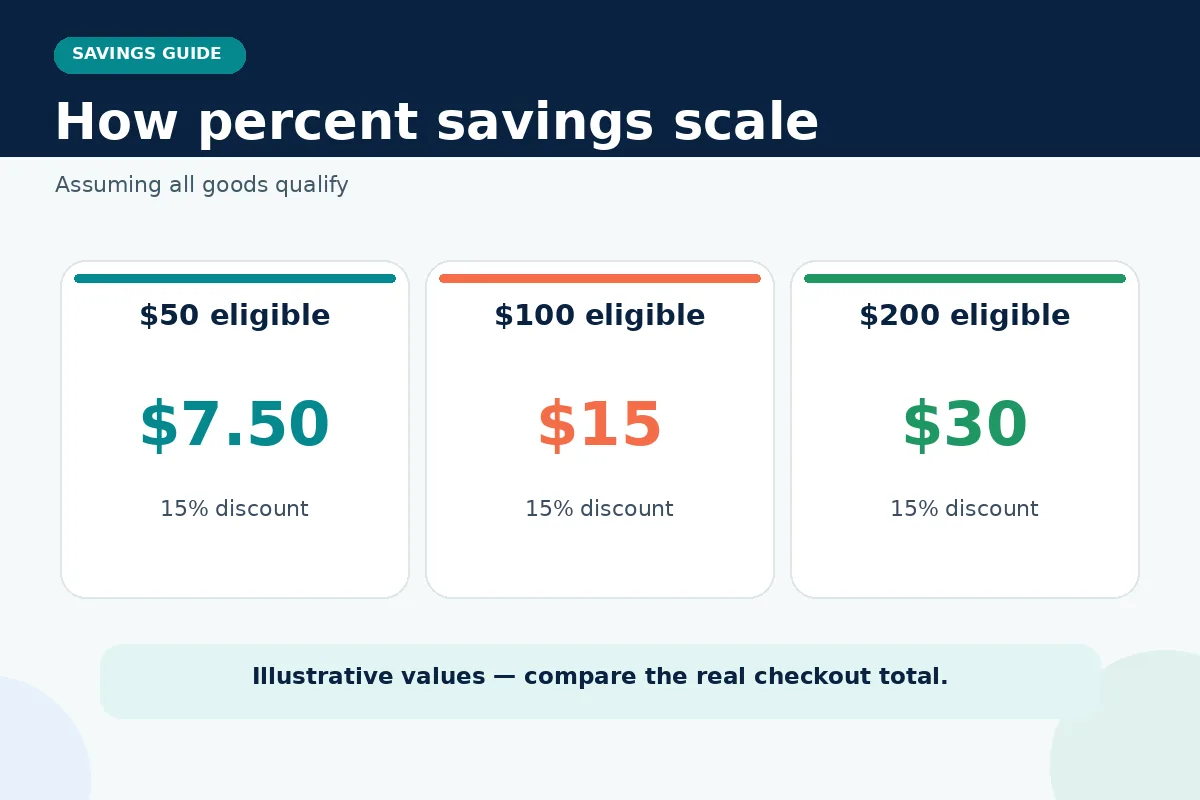
Percentage discounts typically become worth more dollars as the eligible purchase amount grows. A 15% offer saves $7.50 on $50, $15 on $100, and $30 on $200. These calculations assume no maximum discount and that all products are included.
Real merchants can limit a percentage promotion to particular products or collections. Some promotions can also have savings caps. Always calculate from the merchandise value that actually qualifies under the offer.
How Fixed-Dollar Discounts Work
A fixed-amount coupon deducts a specified sum from an eligible order or product. A hypothetical $15-off code reduces an eligible $60 subtotal to $45 before shipping and taxes. Unlike a percentage, the benefit does not increase merely because your cart becomes larger.
Fixed offers may require a minimum qualifying purchase, limit eligible products, or apply only once. A $15 coupon requiring $100 of qualifying merchandise is not a usable alternative for a $60 cart, even if it seems mathematically attractive.
Shopify’s amount-off documentation distinguishes percentage and fixed discounts and explains how minimum purchase amounts are calculated on that platform. Those are examples of configurable merchant rules, not promises that all stores calculate thresholds identically.
The Break-Even Formula: Which Coupon Wins?
When both discounts apply to the same eligible amount and neither has additional limits, the value of a percentage coupon equals the fixed discount at:
Break-even eligible subtotal = fixed discount ÷ (percentage ÷ 100).
For 15% versus $15, calculate $15 ÷ 0.15 = $100. At an eligible subtotal below $100, $15 off saves more; at exactly $100, the two are equal; and above $100, 15% off saves more.
| Eligible subtotal | 15% off saves | $15 off saves | Better option |
|---|---|---|---|
| $60 | $9 | $15 | Dollar-off |
| $100 | $15 | $15 | Tie |
| $160 | $24 | $15 | Percentage-off |
The table is illustrative. It assumes both codes are valid and eligible at each amount, with no minimums, exclusions, caps, or other discounts.
Use the Correct Discount Base
One of the most common mistakes is multiplying the advertised percentage by the entire cart even though only selected items qualify. Suppose you have $120 of merchandise but just $60 is eligible for 20% off. The percentage benefit is $12, not $24. A different fixed-amount offer could apply to the whole order or only designated products, so check its scope separately.
Some platforms calculate product discounts before order-level discounts. If eligible combinations are allowed, the later percentage may operate on a reduced subtotal. This is why abstract formulas are useful for comparing alternatives but the checkout’s actual amount remains definitive.
What If the Percentage Discount Has a Cap?
Suppose a hypothetical promotion offers 20% off with a maximum saving of $20. On $80 of eligible merchandise, the mathematical saving is $16, so the cap does not matter. On $150, 20% would normally be $30, but the capped benefit would be $20. A competing eligible $25-off coupon could then be more valuable even though the percentage headline looks large.
To calculate accurately, use the smaller of the normal percentage reduction and the maximum stated discount. If the offer terms do not disclose a cap, do not invent one; simply check the retailer’s terms.
Minimum Purchase Requirements Can Reverse the Decision
A coupon that requires $120 in eligible spending will not help you on an $80 cart that does not meet the threshold. Minimums can apply to qualifying products rather than taxes or shipping, and the treatment of gift cards and other discounts can vary by platform.
Resist the temptation to add unneeded products to qualify. For example, spending $20 extra to unlock a $15 coupon can still leave you paying $5 more than you would for the planned merchandise, ignoring unrelated price changes.
Consider Shipping, Taxes, and an Existing Deal
The better coupon is the one that produces a lower final price for the same purchase, not necessarily the greater item-level discount. A free-delivery promotion can offset shipping charges instead of merchandise. Taxes may be recalculated after some discounts according to jurisdiction and order details. A typed code can also be incompatible with an automatic offer already in the cart.
If stacking is not permitted, compare one offer at a time. Do not simply add the face values of unrelated coupons. If a store allows combinations, use its displayed discount lines and final amount due rather than assuming a universal arithmetic order.
A Simple Three-Step Comparison Routine
- Determine the qualifying subtotal. Remove excluded items from the percentage base and check that each offer satisfies its minimum.
- Calculate both eligible savings. For percentage off, multiply the rate by the qualifying amount and apply any cap; for dollar off, use the permitted fixed reduction.
- Test at the retailer’s checkout. Compare final totals with identical merchandise, shipping, taxes and other available promotions.
Frequently Asked Questions
Is 20% off better than $20 off?
The two are equal at a $100 eligible subtotal. Below $100, $20 off saves more; above $100, 20% saves more—provided both offers actually qualify and are uncapped.
How do I find the break-even amount?
Divide the dollar discount by the percentage expressed as a decimal. For $12 versus 15%, $12 ÷ 0.15 equals $80.
Can a 20% discount save less than 10%?
Yes, if the 20% offer applies to fewer products, has a savings cap, or conflicts with a stronger automatic discount.
Do shipping and taxes count toward the comparison?
They matter for the final payable total, but they may not count toward the coupon’s eligible subtotal or minimum spend. Check how the retailer defines the base.
Should I spend more to qualify for a dollar-off coupon?
Only if the additional merchandise is something you genuinely want and the complete purchase still offers value. Buying unwanted items can negate the apparent saving.
The Bottom Line
Use the break-even formula as a quick screening tool, then trust the real checkout. On equal qualifying terms, dollar-off wins below the threshold and percentage-off wins above it. Check caps, minimums, exclusions, delivery and tax before deciding.