CouponF5 is an independent publisher. We may earn a commission when you purchase through our links, at no extra cost to you. Merchant terms apply.
In this guide
AIWriteBook
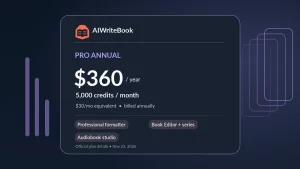
AIWriteBook Pro Annual Plan — 5,000 Credits/Month
AIWriteBook Pro adds 5,000 monthly credits, professional formatting, audiobook creation, Book Editor, translation and series tools. $360 annual billing.
AIWriteBook
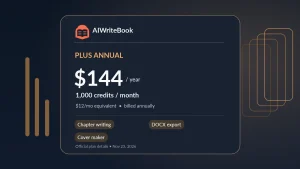
AIWriteBook Plus Annual Plan — 1,000 Credits/Month
AIWriteBook Plus offers 1,000 credits monthly, chapter writing, AI chat, grammar checks, covers and DOCX export. $144 billed yearly, not $12 charged monthly.
Books written with AIWriteBook are showcased on the platform’s public examples page, where the company says authors can share finished projects and offer sample chapters. For readers and prospective authors, the gallery is useful for exploring genres, cover presentation and writing samples. But a book cover in a showcase does not, by itself, establish that the complete manuscript has been edited, that the title is available on Amazon, or that it has earned sales. The right way to evaluate a book created with AI assistance is to read the available text, confirm any retailer listing and judge the finished edition on its own merits.
AIWriteBook provides tools for outlining, chapter drafting, editing, book covers and publishing files. The authors choose their ideas and make the final decisions, according to the merchant. That is a description of its workflow, not a substitute for reviewing an individual author’s work. This guide explains what its public gallery can demonstrate, how to browse examples, and where the evidence ends.
Where can you find books written with AIWriteBook?
The official Books Written with AIWriteBook gallery is the best starting point. The page describes contributions by real authors and organizes the broader audience around fiction, nonfiction, illustrated stories and other author goals. The merchant says visitors can download a preview of the first two chapters in EPUB or PDF when an individual book offers the relevant Preview control. A reader should use those downloadable pages, rather than the cover alone, to judge prose, chapter structure and presentation.
The showcase is dynamic: its featured-book cards were not individually readable in the accessible page text during this research session. Therefore, this article does not invent a current list of individual titles, authors, ratings or Amazon links. Readers should check the live gallery for the actual books available today and verify any external destination separately. A missing or changing gallery card is not proof that a title was never written.
How many books have authors created on AIWriteBook?
AIWriteBook’s first-party platform report covering activity through July 2026 said that 13,683 books had been started between December 31, 2025 and the end of that study window. The same report described 470 books in the public showcase, including 347 fiction and 123 nonfiction projects, and 38 showcase listings with Amazon buy links. These figures are historical snapshots reported by the company itself, not independent sales or current-catalog audits.
The data also makes a distinction that marketing language can blur. A started book, a manuscript with all planned chapters generated, an exported file, a public book page and a title actually offered for sale are not the same milestone. The merchant’s research defines completion using generation of planned chapters, not external publication or professional editing. Authors can revise and export repeatedly, so an export-event count should not be mistaken for the number of commercially released titles.
The company’s separate quality-study report describes source limitations and support complaints around instruction-following, prose quality and manuscript import. Those reports are valuable for understanding the platform’s own operating data, but they were compiled by AIWriteBook rather than an independent evaluator and do not reveal how any specific showcase title performed in the marketplace.
What can you learn from a book’s cover and sample chapters?
A cover can reveal genre positioning, intended audience and how confidently an author communicates a concept. A short sample is more informative: check whether the opening has a clear premise, characters or ideas remain consistent, transitions make sense, and the writing sounds specific rather than repetitive. In nonfiction, look for a logical structure, named sources where needed and claims that can be checked independently.
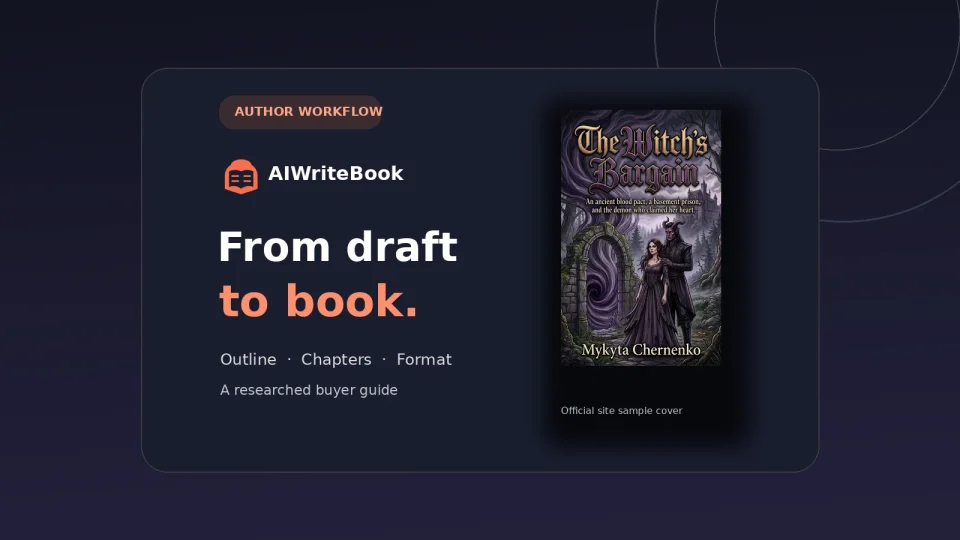
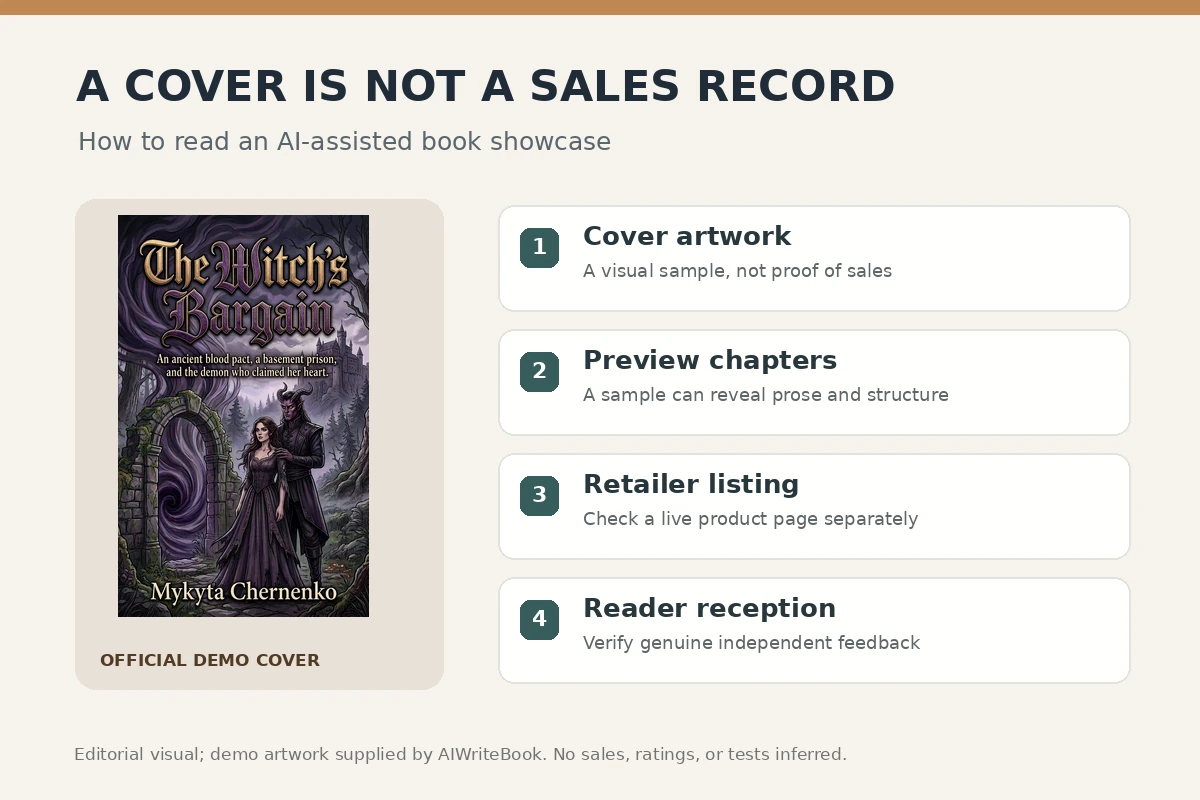
On its homepage, AIWriteBook displays a fantasy-romance illustration for The Witch’s Bargain, which we reproduce in the adjacent editorial infographic using the original merchant image pixels. It is an official cover-generator marketing example. Its appearance on a product page is not independent evidence of a completed, commercially listed book, sales figures or reader reception. Treat such examples differently from a gallery listing with verifiable chapters and a live retailer page.
Does being in the public gallery mean a book is published?
Not necessarily. AIWriteBook’s description of its Author Page feature says that a book with a title, cover and written first chapter can appear on the public author grid when the author enables that visibility. That is a meaningful demonstration of a book project and its discoverability tools, but it is not confirmation that every chapter is finished or that a retailer has accepted the final edition.
A genuinely published title should have additional evidence, such as an accessible retailer listing for the exact title and author, a purchase or reading option and coherent edition details. Even a live Amazon link does not establish whether anyone has bought the book or enjoyed it. Reviews, rankings and earnings require separate reliable evidence. Do not equate a marketing gallery with a verified sales leaderboard.
Which genres can be explored?
The showcase and surrounding platform material describe several categories. Fiction authors may use the tools for romance, fantasy, mysteries, thrillers or science fiction; nonfiction writers may work on business, self-help, expertise-based or personal projects; and visual-book creators may develop children’s picture books or illustrated stories. These are supported types of projects, not a claim that a verified current title exists in every genre.
Evaluate each form differently. In novels, consistency of characters and narrative voice matters alongside pacing. In nonfiction, authority comes from accurate reasoning and checked sources, not the fluency of generated sentences. For illustrated books, inspect whether images remain visually consistent, align with the text, and reproduce cleanly at the intended page size. A polished cover should never override weaker pages within the book.
How should readers check whether a sample is good?
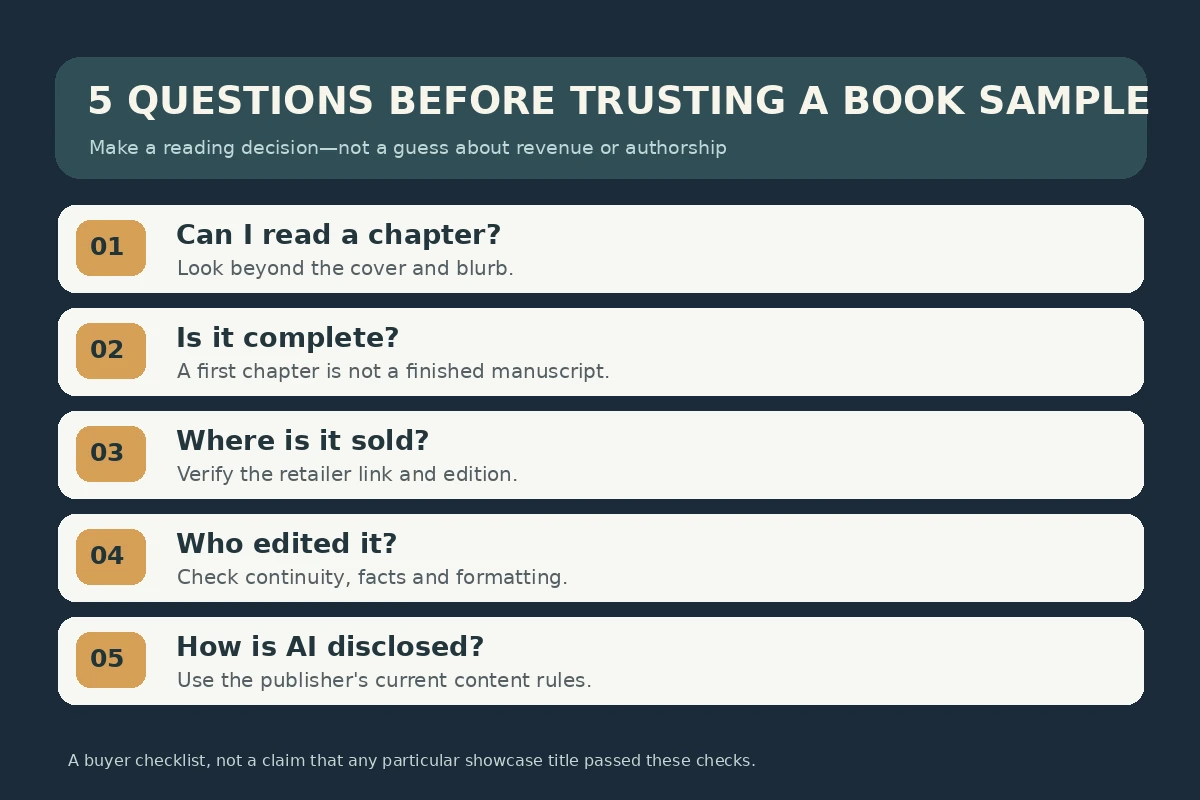
Use a simple evidence-first reading routine rather than relying on promotional adjectives:
- Open the actual book card. Record the exact title, author and genre; avoid relying on an image shared without its source.
- Read a substantial preview. If the merchant offers an EPUB or PDF excerpt, read enough to assess an opening, paragraph rhythm, dialogue or explanations—not just the first few lines.
- Check continuity and accuracy. Look for contradictory names, repetitive scenes, unsupported factual assertions and missing sources when the subject requires them.
- Verify the publication status. Follow the specific retailer listing, when provided, and check that its title, author, edition and format match the book being shown.
- Separate reception from appearance. Seek independent feedback where genuinely available, and avoid treating an AI-generated cover, internal analytics or merchant testimonial as a reader review.
These checks are useful for any self-published book, regardless of whether an AI tool was involved. A human-written work can also be poorly edited, and an AI-assisted work can receive substantial professional revision. Judge the final content rather than assigning a quality score based only on the tool’s name.
What should authors learn from the examples before using the tool?
Start with a comparable genre and format. If you intend to write a character-driven novel, a nonfiction workbook or an illustrated children’s book, read an example in that category and note which expectations a finished project would need to meet. Then build a short outline of your own and test the first chapter before committing to more generation credits. The platform advertises a free planning and initial-chapter path, but paid writing, editing, image and formatting actions can be metered separately.
AIWriteBook’s full workflow may be convenient for keeping an outline, chapters, cover and publication files together. That integration is a feature claim, not proof that the first generated draft is release-ready. Authors remain responsible for correcting facts, improving language, checking rights and testing exported files against the intended publishing platform. A professional editor or dedicated formatting service may still be appropriate for complex projects.
What do Amazon’s AI content rules mean for these books?
Amazon’s Kindle Direct Publishing content guidelines distinguish AI-generated content from AI-assisted content. KDP requires disclosure of AI-generated text, images or translations when applicable, while content created by an author and merely assisted by AI is treated differently. The author or publisher is responsible for accurate disclosure, intellectual-property compliance and the quality of the submitted edition. AIWriteBook’s generation and formatting features do not exempt a title from those rules.
Likewise, an author’s ability to publish or sell work under the software’s Terms of Service does not independently establish that every generated passage qualifies for copyright protection in every jurisdiction. The responsible approach is to document human contributions and verify publishing requirements for the exact project.
Bottom line: use the books as evidence, not a guarantee
The most useful thing about books written with AIWriteBook is the opportunity to inspect what authors choose to show publicly. The gallery can be a starting point for ideas and samples, while a verifiable publication listing provides a different level of evidence. Neither establishes sales, reader satisfaction or consistent output quality without further checks. Read the sample, check the source, evaluate the whole project and decide whether the author’s workflow fits your own goals.
Research disclosure: This article was prepared from AIWriteBook’s public gallery, feature documentation and first-party 2026 reports, plus Amazon KDP’s official rules. CouponF5 did not subscribe, generate or edit a book, download and read a full showcase manuscript, independently audit individual Amazon listings, or verify sales or royalties. The featured image is conceptual artwork, and one infographic displays an actual AIWriteBook marketing sample cover with its limited evidentiary status clearly identified.
AIWriteBook
AIWriteBook Pro Annual Plan — 5,000 Credits/Month
AIWriteBook Pro adds 5,000 monthly credits, professional formatting, audiobook creation, Book Editor, translation and series tools. $360 annual billing.
AIWriteBook
AIWriteBook Plus Annual Plan — 1,000 Credits/Month
AIWriteBook Plus offers 1,000 credits monthly, chapter writing, AI chat, grammar checks, covers and DOCX export. $144 billed yearly, not $12 charged monthly.