CouponF5 is an independent publisher. We may earn a commission when you purchase through our links, at no extra cost to you. Merchant terms apply.
In this guide
Online coupons can be worth using when they lower the total cost of something you already planned to buy. But a coupon is not automatically a good deal. The real value depends on the eligible savings, shipping charges, added purchases, the time required, and whether the promotion works at checkout.
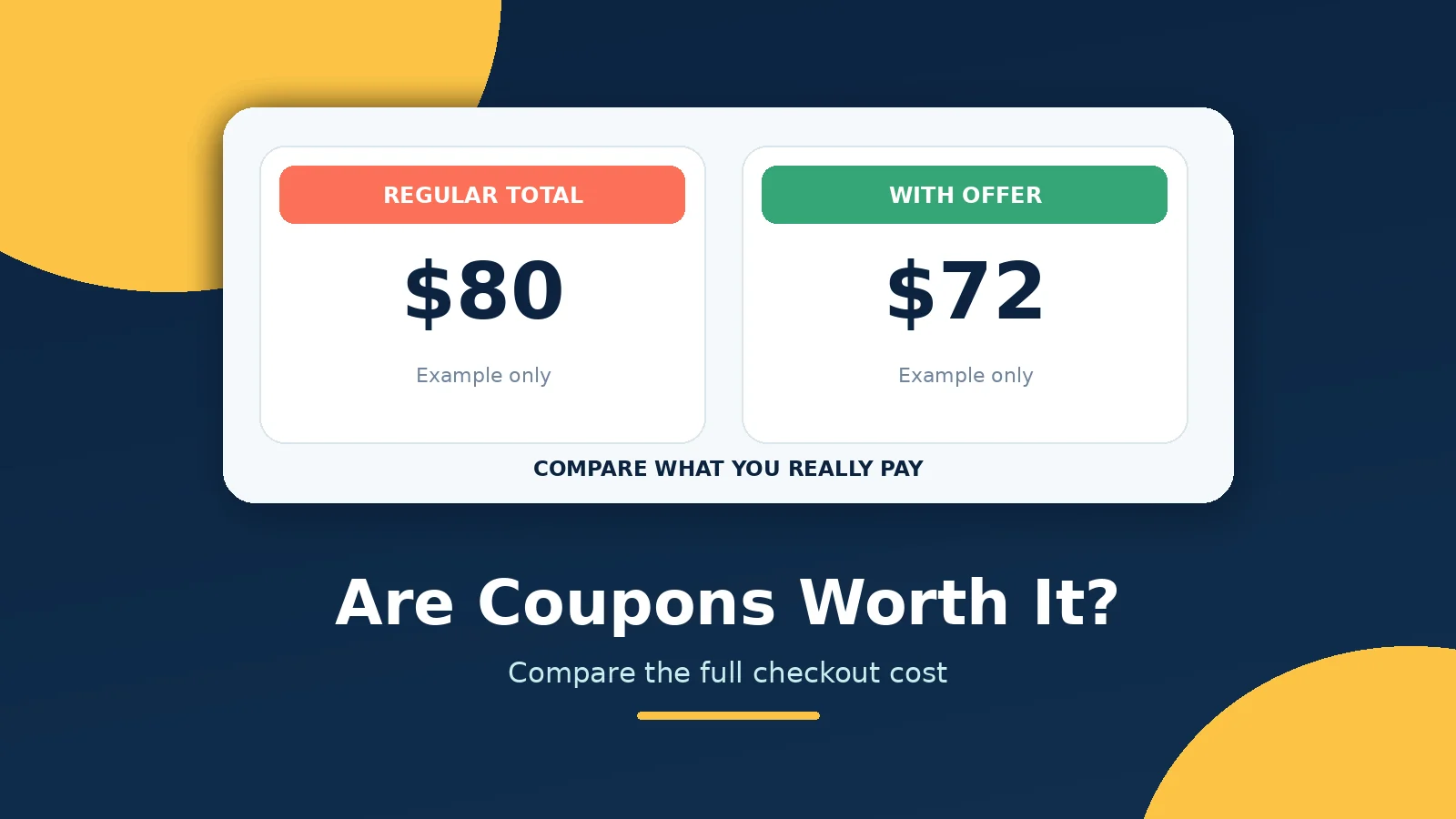
If a code saves $8 on a planned $80 purchase with no other downside, that can be worthwhile. If the same code pushes you to add a $20 item you do not need, the apparent discount can become extra spending. The most useful question is not “How big is the offer?” It is “Would my final order cost less than it would without this promotion?”
When Online Coupons Are Worth Using
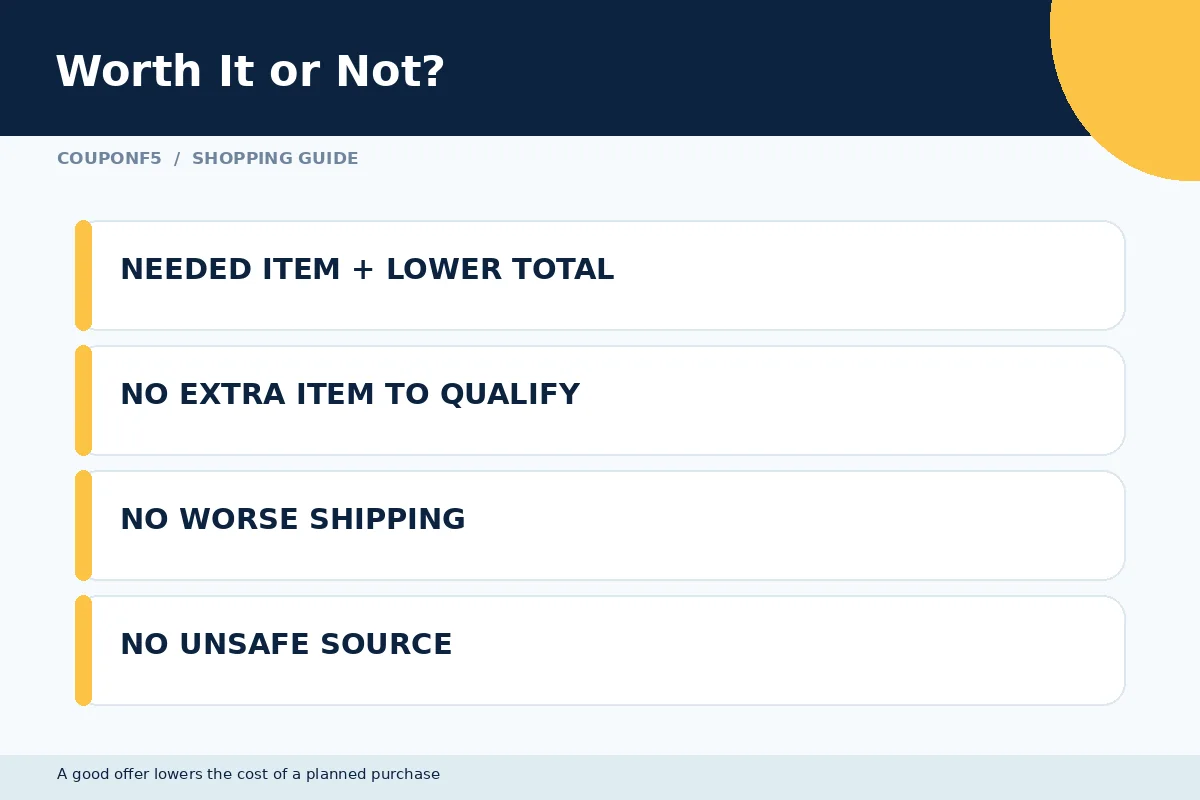
A coupon tends to be worthwhile when four conditions line up: you intended to purchase the item, the offer is legitimate, your order meets the terms, and the resulting checkout total is lower than your best available alternative.
Coupons may discount eligible products, reduce shipping, or provide another qualifying benefit. The precise effect matters. An automatic sale or a retailer’s existing promotion can already be better than a code found elsewhere. A third-party listing promising a percentage is not a guaranteed reduction.
The Savings Math: Compare Final Checkout Totals
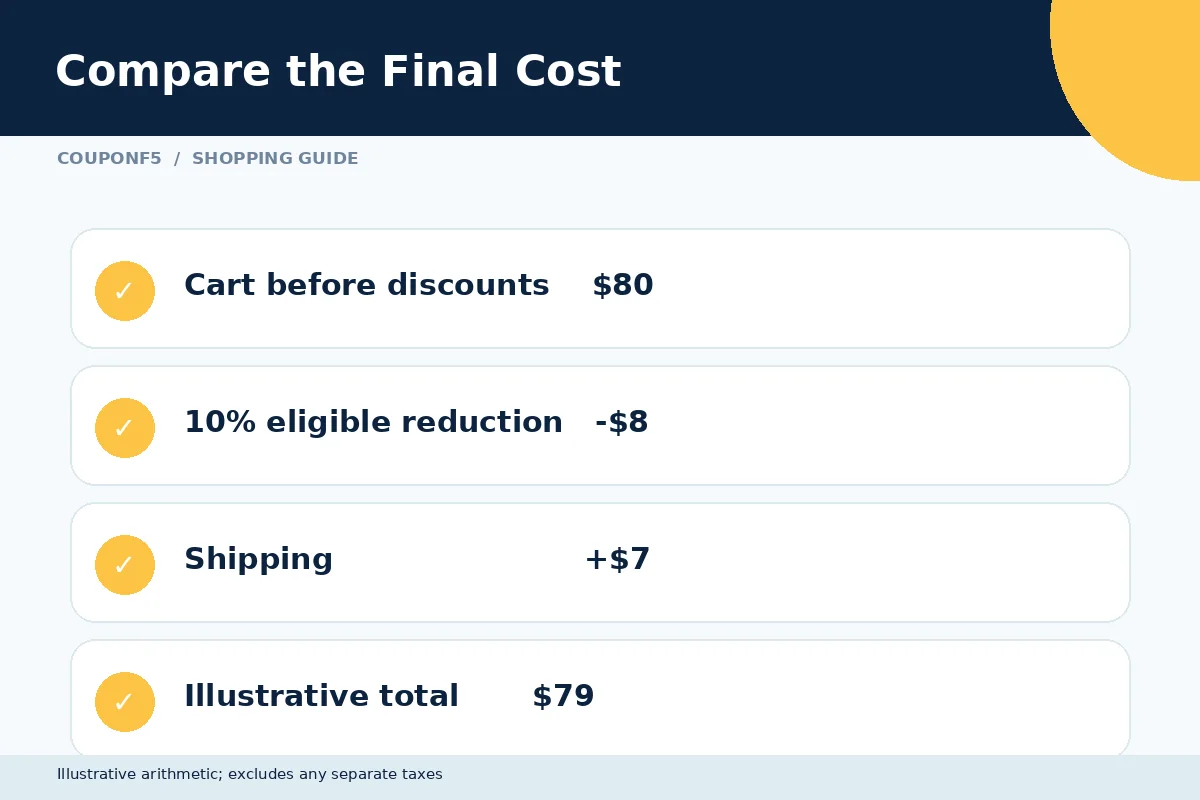
Consider a hypothetical purchase with an $80 eligible item subtotal. Without a discount, the products cost $80. With a hypothetical 10% item discount, the product subtotal becomes $72. If shipping is $7 in both cases and taxes are excluded from the illustration, the corresponding totals are $87 without the coupon and $79 with it. The coupon saves $8.
Now imagine an alternative free-shipping offer. That order would total $80 before any applicable taxes, meaning the 10% product coupon is $1 better in this particular example. These calculations are illustrations only; they are not current offers from a real store.
To compare fairly, use the same items, delivery method, return requirements, and timing. If a promotion changes a shipping service or excludes an item, its headline savings may not represent an apples-to-apples comparison.
Five Questions to Ask Before Applying a Coupon
1. Was I going to buy this anyway?
This is the biggest test. Saving 15% on an unplanned $200 purchase does not make the remaining $170 free. If the item was not in your shopping plan, the coupon might encourage more spending than it prevents.
2. Is the offer real and applicable?
Find the exact conditions on the merchant’s official website or from a source you can verify. Discounts may have end dates, product exclusions, account requirements, or maximum uses. Even an active code can fail on your specific cart.
3. What amount does it actually deduct?
A code might apply to only one eligible product instead of the entire order. It may also be capped. Look for the discount line and adjusted subtotal at checkout, not just a banner claiming savings.
4. What does it do to shipping and other promotions?
A new code could be incompatible with an automatic discount, and the shipping savings might be larger than an item discount. Retailers choose their own combination rules. Shopify’s discount-combination guidance illustrates that some product, order, and shipping promotions can combine when merchants permit it; others cannot.
5. Is the effort and risk reasonable?
Spending two minutes checking a retailer’s advertised offer may be sensible. Paying an unknown third-party website to unlock a supposed coupon or exposing account credentials to a suspicious link is not a good trade-off.
When a Coupon Can Cost You More
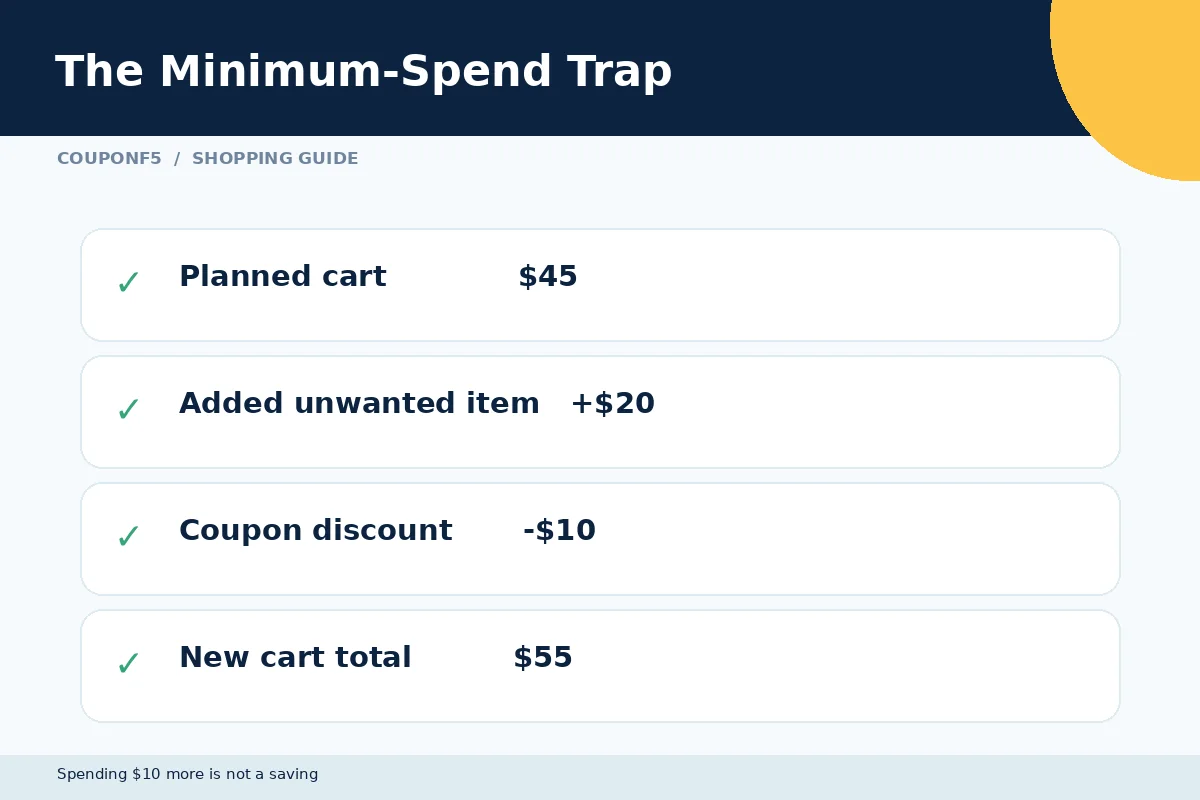
Minimum-spend promotions are a common example. Suppose your planned cart is $45. You see a hypothetical $10-off code that requires a $60 qualifying subtotal. You add an unwanted $20 item just to qualify. Your resulting $65 subtotal minus $10 becomes $55. That is $10 more than the original planned $45 purchase, before any other differences in shipping and taxes.
This does not mean every minimum-order offer is bad. If you genuinely needed the additional item and would purchase it soon anyway, it may be reasonable to buy together. The mistake is treating the coupon as a savings achievement while ignoring the extra expense.
Similar problems arise with an unfamiliar retailer offering an implausibly low price, a coupon attached to a subscription you did not want, or a gift promotion that requires a higher-priced bundle. A “free gift” is an added item, not necessarily cash saved.
Are Percentage Coupons Better Than Dollar-Off Coupons?
Neither type always wins. Calculate each offer on the qualifying amount. A hypothetical 15% discount on $60 saves $9; a $12-off coupon would save more if both offers apply under comparable conditions. On $100, 15% would save $15 and beat $12 off. Exclusions, minimums, limits, and stacking rules can change the outcome.
Free-shipping coupons deserve a separate comparison because their value depends on the shipping charge that would otherwise apply. A waived $5 delivery fee is worth $5, not the amount of the item subtotal.
Should You Search for Codes Every Time You Shop?
A quick check is often reasonable for an order you have already decided to place. Look at the merchant’s current promotions, account offers, or a reputable coupon directory. If nothing credible appears, you can proceed without a code or delay the purchase if timing is flexible. There is no reason to keep trying arbitrary strings for an extended period.
Shopify’s discount-method overview notes that merchants may use either typed codes or automatic discounts. A checkout with no coupon field or accepted code may already have a reduction built into the displayed price.
Are Coupon Websites Safe to Use?
A coupon directory can be a discovery tool, but it does not guarantee that a code is current or applicable. Check the listing’s source and terms, then verify the actual price on the real merchant site. Be cautious if a page requests payment, login credentials, or a software installation just to reveal a code.
The Federal Trade Commission warns that a fraudulent message may offer a coupon for free goods as a lure. Reach the merchant through a known address rather than an unexpected message when the offer seems suspicious.
A Practical Rule for Deciding if a Coupon Is Worth It
Use the offer if the following statements are true:
- The item or service was already wanted and fits the budget.
- The discount source and merchant destination appear legitimate.
- The offer applies to the actual cart and is visible before payment.
- The final price is lower than your best realistic alternative.
- You did not have to accept an unwanted product, fee, or obligation.
Otherwise, consider skipping the offer. Not redeeming a coupon does not mean you missed out on savings; sometimes it means you avoided an unnecessary purchase.
Frequently Asked Questions
Do online coupons really save money?
They can, when a qualifying promotion reduces what you pay for a planned purchase. The confirmed savings appear in the merchant’s order summary, not just on a coupon page.
Is it worth adding items to meet a coupon minimum?
Only when the extra items are genuinely needed and the total still represents good value. Buying unwanted merchandise solely to unlock a code may increase spending.
Why do some coupons seem to save nothing?
The items may be excluded, the code may be inactive, or an existing promotion may already be better. Compare the final checkout amount before and after applying the offer.
Should I trust a very large discount from a new store?
Not automatically. Verify the seller, domain, payment conditions, and product price independently. A dramatic offer is not evidence that the store is genuine.
Can coupons stack with automatic discounts?
Sometimes. Combination rules depend on the merchant’s settings and the discounts involved. Confirm the combined reduction in checkout.
The Bottom Line
Online coupons are worth using when they reduce the cost of an otherwise sensible purchase. Compare complete checkout totals, avoid threshold-driven overspending, and verify the offer on the retailer’s real website. The best coupon is the one that makes your planned purchase cheaper—not the one with the most attention-grabbing claim.