CouponF5 is an independent publisher. We may earn a commission when you purchase through our links, at no extra cost to you. Merchant terms apply.
In this guide
Using coupons when shopping online can be worthwhile because an eligible offer may lower your item total, reduce delivery charges, or make a purchase you already planned more affordable. But the smartest reason to use a coupon is not simply that it exists. It is that the offer reduces what you actually pay for something you genuinely need.
Online coupons come in different forms, including typed discount codes, automatically applied promotions, and account-specific offers. The best way to benefit is to compare the final checkout price, understand the conditions, and avoid spending extra just to qualify for a discount.
1. You May Pay Less for the Same Planned Purchase
A qualifying percentage-off or fixed-dollar coupon can reduce the price of eligible products without changing what you buy. That is the clearest benefit: you complete a planned purchase for less money.
Imagine an eligible $100 cart before tax and delivery. A hypothetical 10% discount would save $10, leaving a $90 eligible subtotal. A hypothetical $15-off offer would save $15, leaving $85. If both were valid individually and could not be combined, the fixed-dollar coupon would be better for this cart.
These are examples, not active offers. A real code may apply only to some cart items, require a minimum spend, or have a maximum savings cap. Always check the amount actually removed from your order.
2. Coupons Can Reduce Shipping Costs
Shipping charges sometimes make a seemingly attractive product more expensive. A free-shipping coupon can help when delivery would otherwise cost more than the merchandise discount you could obtain.
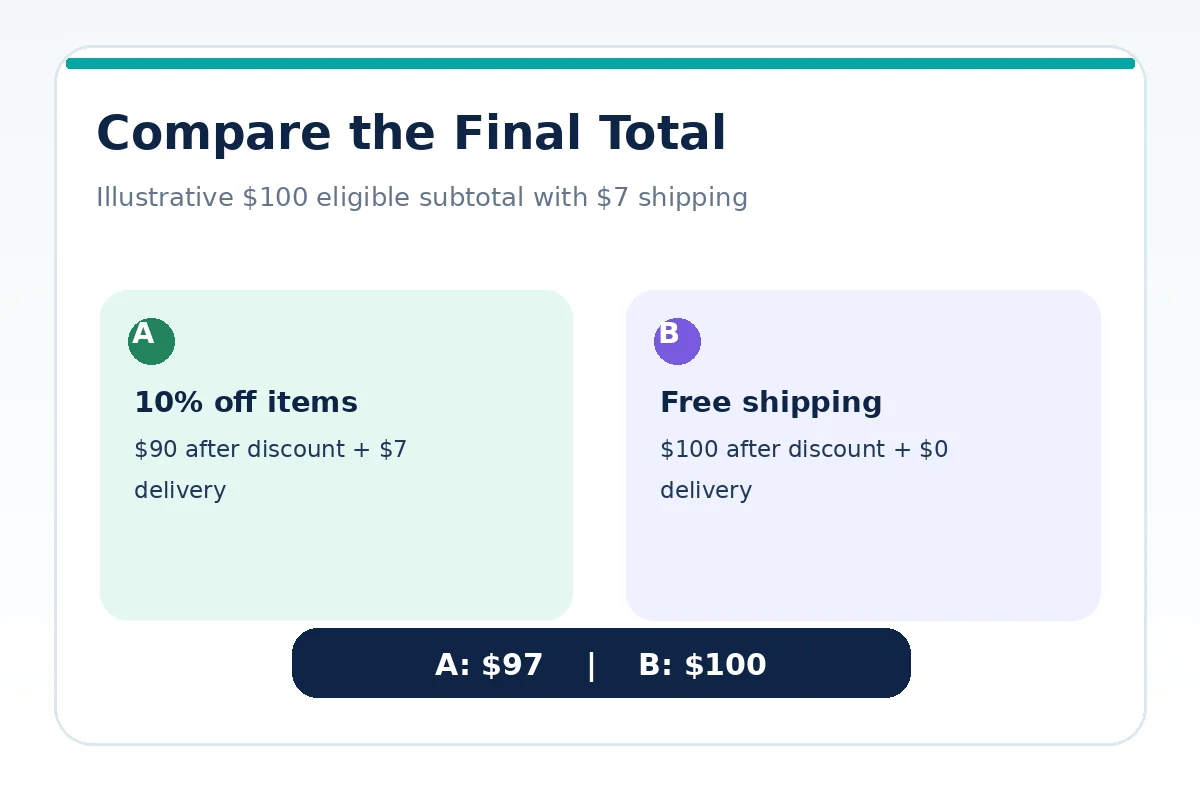
For example, consider a hypothetical $100 eligible subtotal with $7 shipping. If you can choose only one promotion, 10% off eligible products produces $90 in products plus $7 shipping, or $97 before tax. A free-shipping offer gives $100 in products plus $0 shipping, or $100 before tax. Here, the item discount wins by $3. If shipping were $12 instead, the free-shipping offer would be more valuable by $2. This comparison is illustrative.
Before choosing, see whether a free-shipping promotion applies to your destination, delivery method, or order value. Do not assume every shipping service is included.
3. You Can Compare Different Kinds of Offers
Coupons are not all interchangeable. Retailers can offer percentage reductions, fixed-dollar reductions, free delivery, or purchase-based promotions. The Shopify discount-type documentation, for example, distinguishes amount-off, shipping, and buy-X-get-Y discounts.
Comparing offers is useful because the best-looking percentage is not necessarily the best deal. A $10 coupon may beat 15% off when the eligible subtotal is less than about $66.67, assuming neither has special restrictions. At larger eligible subtotals, 15% could be worth more. The break-even point changes if shipping, maximum discounts, or exclusions apply.
Rule of thumb: translate every offer into dollars saved on your actual cart, then compare the final payable total.
4. Some Promotions Reward Eligibility You Already Have
Retailers may make offers available to first-time shoppers, newsletter subscribers, loyalty members, or a designated customer group. If you already meet the criteria, the discount may be a convenient benefit of the account or relationship you have with the merchant.
However, an account-specific coupon should not be treated as a guaranteed public offer. Some promotions require a login, restrict redemption to one purchase, or expire after a certain date. Only share the personal information needed for an account you actually want to use, and be cautious about suspicious coupon messages.
5. Coupons Encourage You to Check the Total Before Paying
The process of applying a coupon provides a useful pause at checkout. You can review the item subtotal, any applied price reductions, shipping, estimated taxes, and the final amount due. This matters because a coupon headline may sound impressive while producing little or no savings on your particular purchase.
A discount code that is accepted but reduces only one qualifying item may have a smaller effect than expected. A promotion might also exclude clearance merchandise or require a higher minimum than your eligible items meet. The order summary—not a coupon banner—shows what changed.
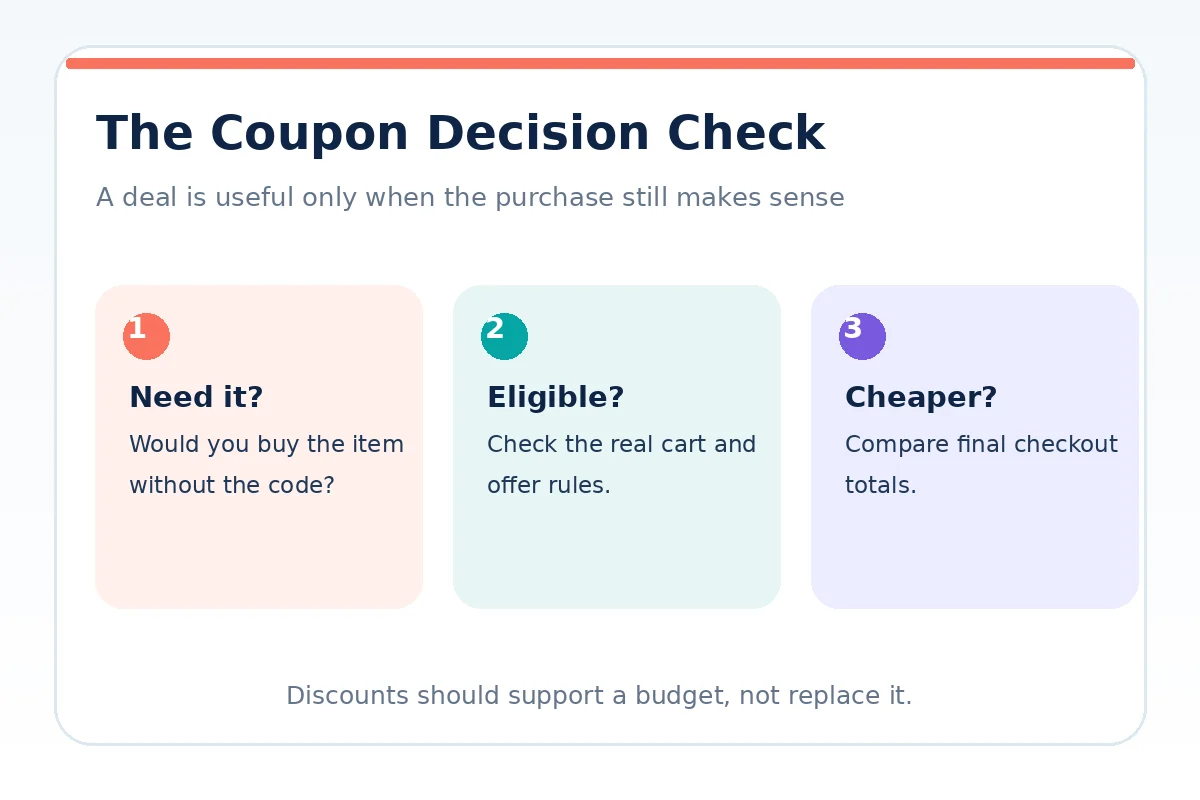
For a quick evaluation, ask three questions:
- Would I buy the item without the offer? If the answer is no, a discount may be turning an unnecessary purchase into spending.
- Does my actual cart qualify? Confirm eligible products, dates, customer restrictions, minimums, and stacking rules.
- Is the full order cheaper? Check the final price, including delivery and taxes where shown.
6. You May Avoid Paying More Than Necessary
Coupon discovery can be especially useful for purchases you have already compared across retailers. If two sellers offer the same item and relevant conditions, a legitimate discount may affect which final price is lower. But compare like with like: delivery speed, return conditions, available sizes or models, and retailer reliability also matter.
A coupon should be the last part of a sensible buying decision, not the first. A lower checkout price does not automatically make a poor-fitting product or an unreliable merchant a better option.
7. Discounts Can Fit into a Budget—When Used Carefully
If you routinely buy certain products online, discounts on planned purchases may help leave room in your budget for other priorities. This benefit depends on consistent decisions, not on chasing the highest advertised discount.
Suppose you planned to spend up to $60 on an item. A coupon that lowers a qualifying $58 item to $50 can support that budget. But buying an additional $25 item just to qualify for a $10 coupon means you spent $15 more than you otherwise would, assuming you would not have purchased the extra item.
Be especially careful with countdown timers, minimum-spend thresholds, or “one more item” suggestions. A promotion’s terms may be real, but that does not make the extra purchase worthwhile.
When Using a Coupon Might Not Be a Good Idea
A coupon may not create meaningful savings when it has a strict minimum spend, applies only to unwanted items, removes an otherwise better offer, or comes from a suspicious source. Do not purchase solely because you have a code.
- You must exceed your budget: an additional purchase costs more than the discount earned.
- A better promotion is already applied: replacing an automatic deal could raise your total.
- The offer is restricted: excluded products, geography, account status, or use limits prevent the intended discount.
- The source is suspicious: an unsolicited message asks for passwords or payment information to unlock a coupon.
The FTC’s phishing guidance notes that scammers may use supposedly free coupons to lure recipients into unsafe actions. Check the merchant’s authentic website rather than trusting an unexpected link.
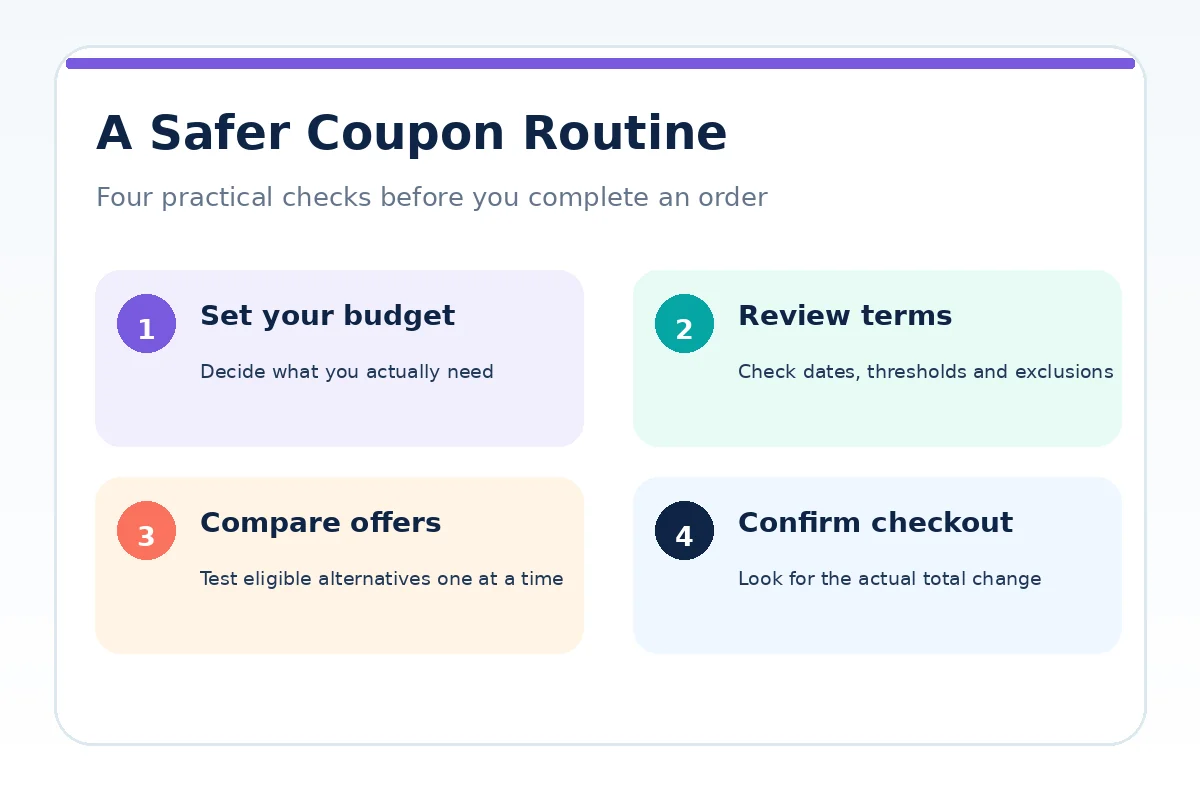
How to Use Coupons More Effectively: A Simple Routine
- Decide what you need. Compare products on quality, compatibility, returns, and the regular cost before looking for a discount.
- Set a spending limit. Choose a reasonable maximum, including likely shipping and tax.
- Check legitimate offer sources. Read the merchant’s current promotion terms, account offers, or reputable coupon listings.
- Compare one promotion at a time. If the checkout does not permit stacking, try eligible alternatives and keep the better final total.
- Confirm the discount before payment. Look for a reduction in the order summary and keep the receipt for your records.
Stores configure discount combination rules differently. As explained in Shopify’s combination guidance, applying multiple discounts depends on whether each discount is configured to combine with the others. There is no universal rule that every retailer accepts multiple coupon codes.
Frequently Asked Questions
Do online coupons always save money?
No. They save money only if they reduce what you would otherwise pay for a purchase you intended to make. Eligibility rules and extra spending can erase the apparent benefit.
Are percentage coupons better than dollar-off coupons?
It depends on the eligible order amount and the terms. Calculate the dollar value of each offer on your own cart instead of comparing the headline numbers alone.
Can I combine a coupon with an automatic discount?
Sometimes. A store may allow eligible combinations or may restrict certain promotions. The checkout will determine which permitted discount or set of discounts applies.
Should I create an account just to get a coupon?
Only if the account and its terms make sense to you. Consider the discount, sign-up requirements, privacy expectations, and whether you actually want the merchant’s emails or membership.
Is free shipping always the best coupon?
No. Compare the delivery fee saved with the item discount you would otherwise receive, and look at the final checkout total.
The Bottom Line
Coupons are useful when they lower the cost of a purchase you already planned. They can reduce product or delivery costs and make it easier to compare offers. A smart shopper checks the terms, resists unnecessary add-ons, and makes the decision using the final order total—not the discount headline.