CouponF5 is an independent publisher. We may earn a commission when you purchase through our links, at no extra cost to you. Merchant terms apply.
In this guide
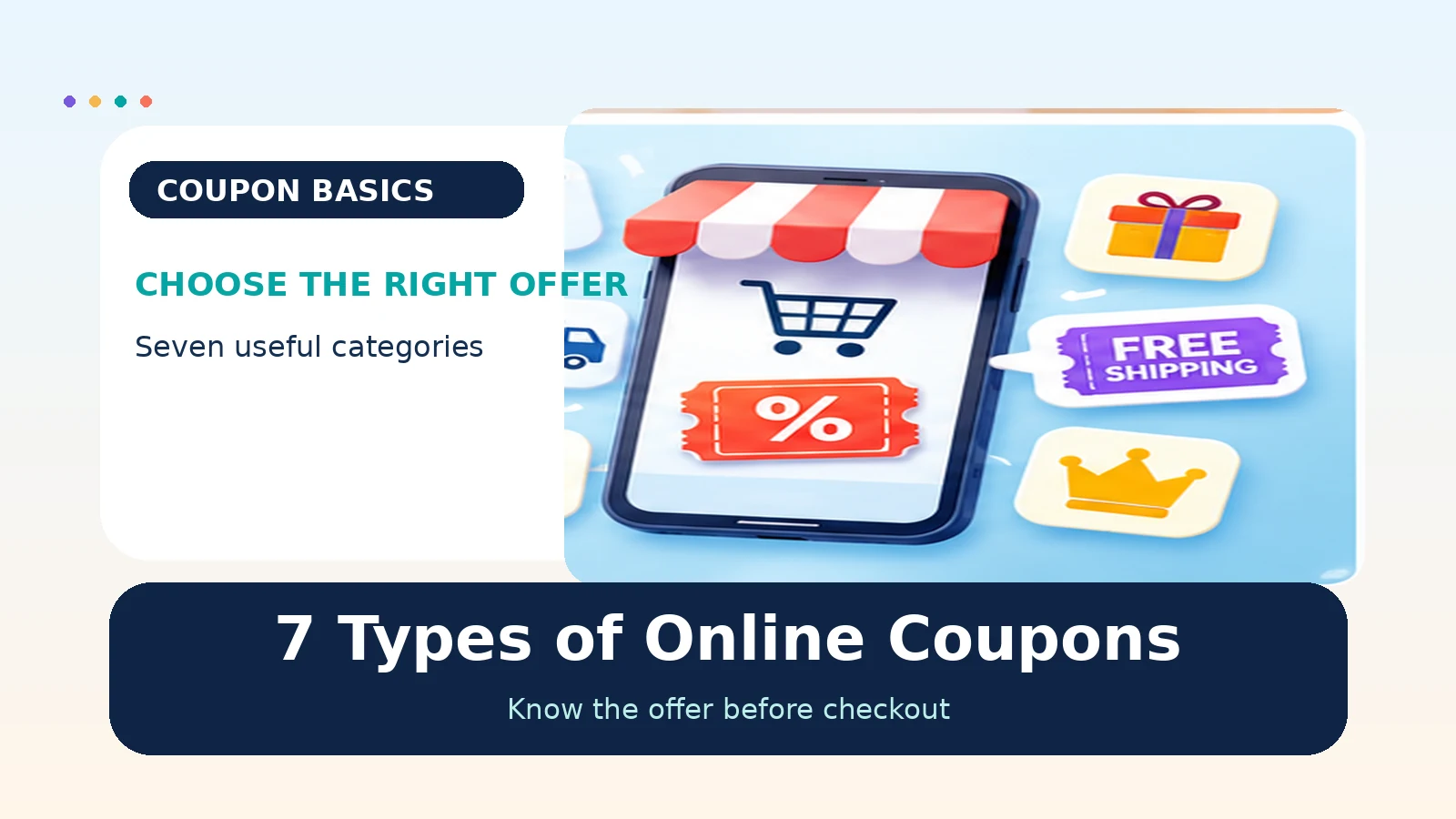
The seven types of coupons worth knowing are percentage-off, fixed-dollar-off, free-shipping, buy-one-get-one (BOGO), free-gift, welcome or loyalty, and seasonal coupons. Each can help with a different shopping situation, but some reduce the price of items while others offer shipping benefits, extra products, or discounts for a particular customer group.
These seven categories are a practical shopper’s guide, not a universal technical classification. The first five describe the benefit. The final two describe who qualifies or when an offer runs. A seasonal coupon can also be a percentage-off coupon, and a welcome coupon might include free shipping. The retailer’s actual rules determine how it works.
Coupon Types at a Glance
| Type | Typical benefit | Best thing to check |
|---|---|---|
| 1. Percentage-off | A share of the eligible price is discounted. | Qualifying subtotal, caps, and product exclusions. |
| 2. Fixed-dollar-off | A set dollar amount is deducted. | Minimum spend and whether it applies to one item or the order. |
| 3. Free-shipping | Eligible delivery charges are reduced or waived. | Shipping method, location, and threshold. |
| 4. BOGO | An additional qualifying item is free or discounted. | Exact products, quantities, and cheaper-item rules. |
| 5. Free-gift | An extra eligible product is included after conditions are met. | Gift selection, stock, and qualification. |
| 6. Welcome or loyalty | Benefits offered to a customer group. | New-customer or member eligibility. |
| 7. Seasonal | A campaign running during a specific period. | Valid dates, exclusions, and demand-driven buying. |
1. Percentage-Off Coupons
A percentage-off coupon reduces the price of qualifying items or a qualifying order by a percentage. For example, an illustrative 20% coupon on an eligible $75 subtotal would save $15, leaving $60 before separate shipping and tax.
When it helps: a percentage discount can be appealing for larger eligible purchases because the dollar value usually increases with the qualifying subtotal.
What to watch: some offers cap the total discount, exclude brands or items, or require a minimum spend. A “20% off” headline does not mean every item in your cart necessarily receives 20% off.
2. Fixed-Dollar-Off Coupons
A fixed-dollar coupon subtracts a specified amount when its conditions are met. An illustrative $12-off coupon on an eligible $60 order reduces the relevant subtotal to $48 before separate charges.
When it helps: a fixed discount can be more valuable than a percentage offer for smaller qualifying carts. On a hypothetical $60 subtotal, $12 off is more than 15% off, which would save $9.
What to watch: the order minimum may be higher than your planned purchase, and the amount may apply to a whole order or to a particular item. Check how the retailer calculates it.
3. Free-Shipping Coupons
Free-shipping coupons reduce eligible delivery fees. Some require a code, while others are automatic when a qualifying order reaches a spending threshold. A retailer may limit the offer to a particular region or delivery service.
When it helps: the waived delivery charge can be more valuable than a small item discount, especially for a modest qualifying purchase.
What to watch: free shipping does not always mean free express delivery or waive handling charges. A minimum spend can also make an apparently free delivery option cost more overall if you add unwanted products.
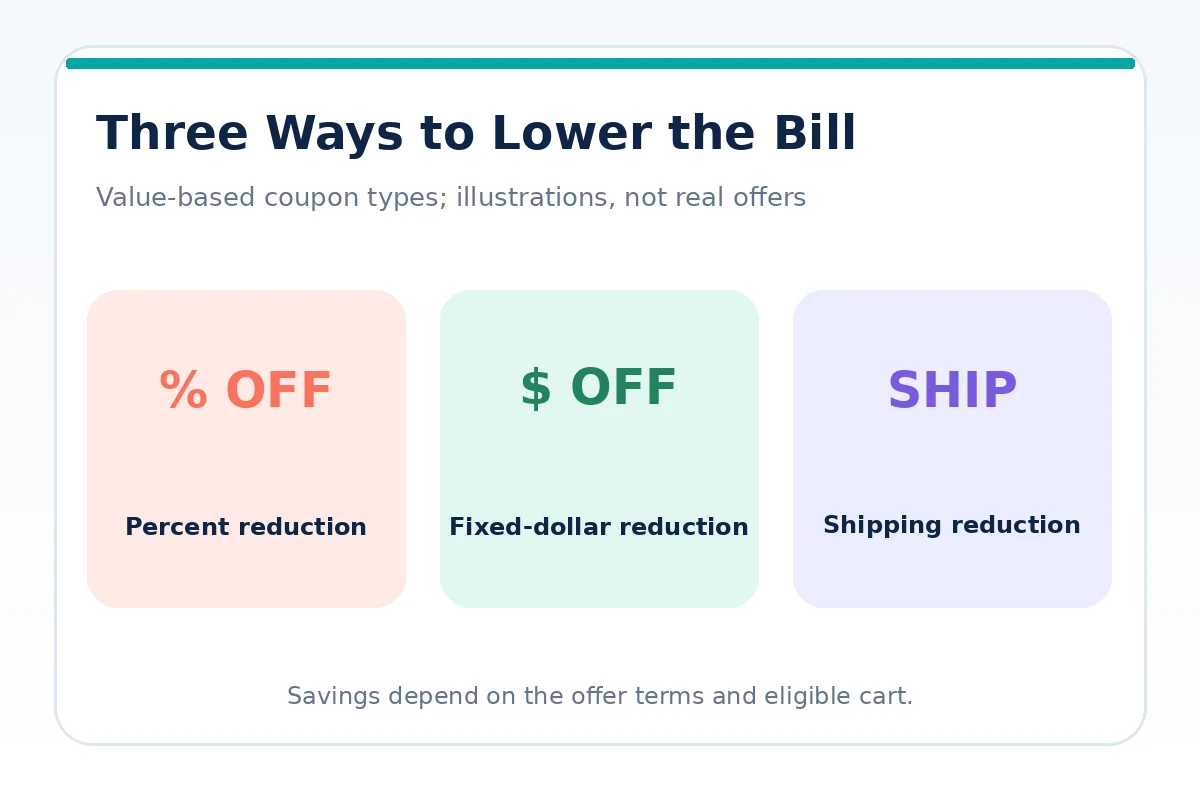
Shopify’s official guide to discount types includes amount-off, free shipping, and buy-X-get-Y offers, which merchants may configure for eligible carts.
4. Buy-One-Get-One (BOGO) Coupons
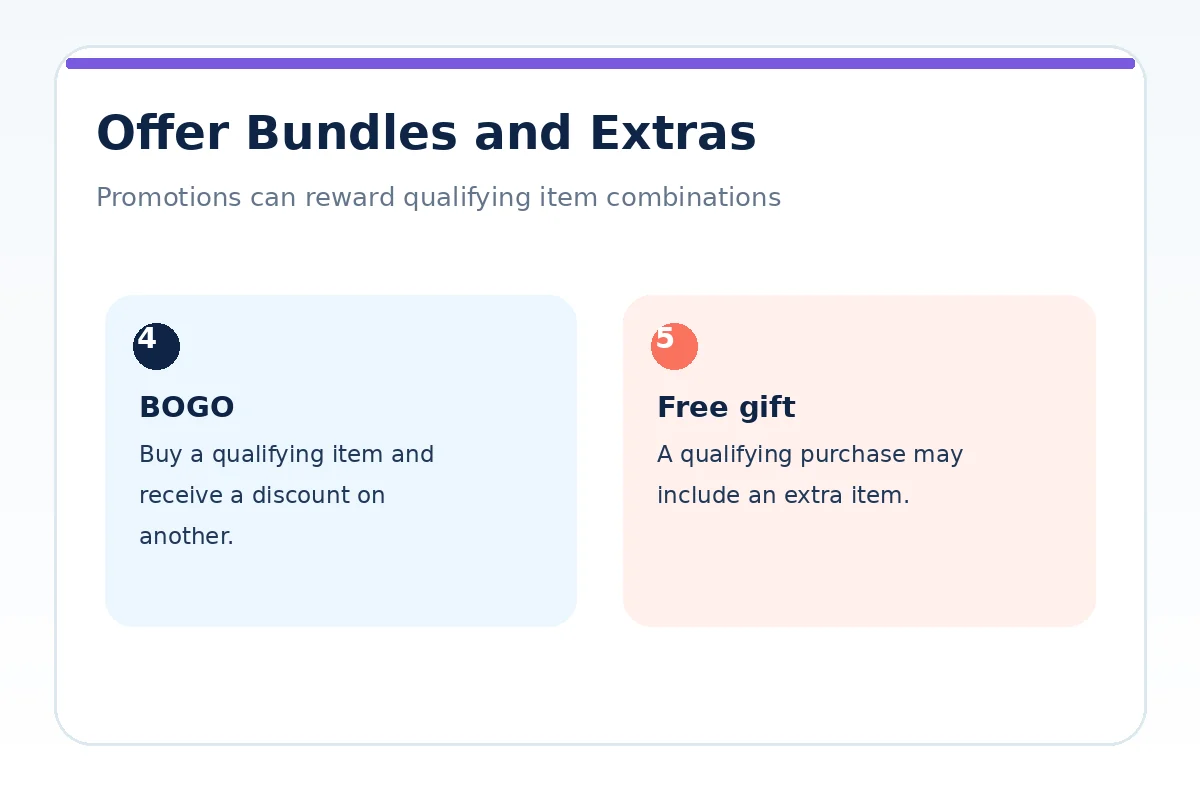
A BOGO coupon rewards a qualifying purchase with a discount on an additional eligible item. Despite the familiar wording, not every BOGO offer is literally “buy one, get one free.” Some provide a second item at a partial discount, while others require different quantities.
When it helps: BOGO can be useful when you planned to buy multiple eligible items anyway, such as two of the same consumable product.
What to watch: specific product and quantity rules. On some platforms, the shopper must add both the qualifying and the discounted item to the cart. Shopify’s Buy X Get Y documentation explains that all required items must be added for the rule to apply. Other stores may implement promotions differently.
5. Free-Gift Coupons
A free-gift offer adds or makes available an extra qualifying product after the cart satisfies the promotion terms. The “gift” may be selected from an allowed list, subject to inventory, or only available with a certain purchase.
When it helps: if the bonus item is genuinely useful to you and you were already going to make the qualifying purchase, it may improve the value of the order.
What to watch: the item’s usefulness, eligible product rules, gift availability, and any extra shipping cost. A free gift is not the same as cash savings. Certain commerce systems support these campaigns; Adobe Commerce documents a free-gift cart promotion, but the feature and store behavior are not universal.
6. Welcome and Loyalty Coupons
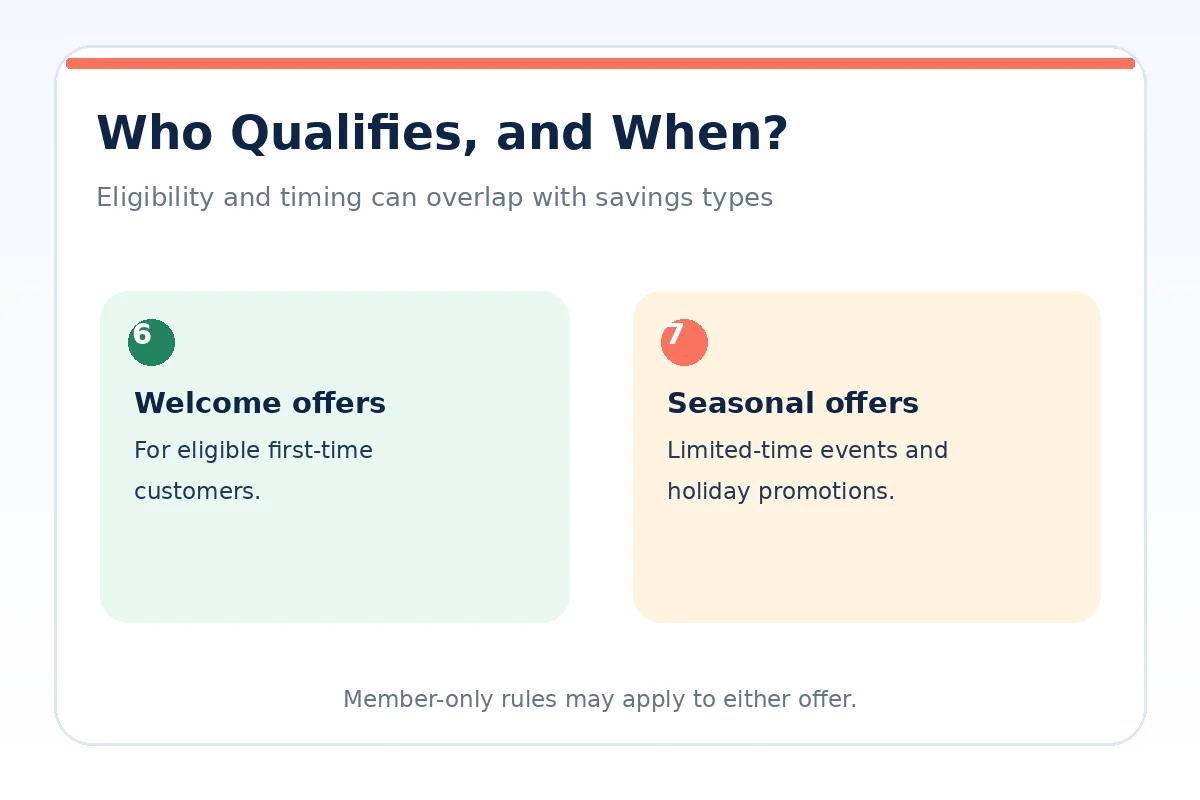
Welcome coupons target eligible first-time customers. Loyalty or member coupons may be reserved for shoppers who participate in a retailer’s account or rewards program. We group them here because the key feature is who qualifies, not the mathematical form of the discount.
When it helps: a buyer who already intended to shop at the retailer may benefit from an eligible first-order or account offer.
What to watch: whether “new customer” means first purchase, first account, or another merchant-defined condition; whether a loyalty tier is required; and whether signing up creates ongoing obligations or marketing messages.
A welcome coupon can simultaneously be a percentage-off coupon. Counting those labels as separate “stackable” discounts would be a mistake unless the retailer explicitly permits combination.
7. Seasonal and Holiday Coupons
Seasonal coupons are offers associated with specific shopping periods, such as holiday campaigns or end-of-season promotions. They may reduce prices, provide free delivery, or reward certain purchases. Their defining feature is timing, not a unique savings formula.
When it helps: it can be sensible to time an already-planned, nonurgent purchase around a legitimate seasonal promotion after checking the current price and terms.
What to watch: limited validity, inventory, product exclusions, and pressure to buy quickly. A countdown or seasonal label does not establish that the advertised price is the lowest available.
Which Coupon Type Is Best for Your Cart?
The best type depends on what you are buying and whether you would have purchased it without a promotion. Consider these illustrative comparisons:
- For a larger eligible cart: a percentage coupon may save more dollars than a small fixed reduction, if it has no lower cap or conflicting conditions.
- For a smaller eligible cart: a fixed-dollar offer may provide more value than a modest percentage reduction.
- For high delivery charges: shipping savings can exceed the value of a product discount.
- For repeat products you actually need: BOGO could be valuable when both units qualify and you will use them.
- For a one-time purchase: a welcome offer may help if you qualify without adding unwanted items.
- For gifts or bundles: count an extra item only if it has real value to you; it does not reduce the amount of cash you spend unless the order total changes.
How to Compare Coupons Without Getting Tripped Up
- Start with your intended cart. Avoid changing what you need simply to trigger a bigger-sounding offer.
- Convert the benefit to dollars. For a percentage discount, multiply the qualifying subtotal by the percentage. For shipping, compare the charge that would otherwise apply.
- Check all restrictions. Look for expiration dates, excluded products, minimum purchase amounts, customer eligibility, and redemption limits.
- Check whether offers combine. Do not assume that a holiday coupon and a welcome coupon can be stacked. Some retailers permit certain combinations; others do not.
- Look at the final payable amount. Confirm the promotion in the checkout order summary before paying.
Keep in mind that coupon categories overlap. An automatic seasonal promotion can provide 15% off, while a typed welcome code can provide free shipping. The benefit, audience, timing, and application method are separate characteristics.
Common Mistakes With Different Coupon Types
- Comparing percentages without doing the math. The same percentage can produce very different dollar savings at different qualifying subtotals.
- Assuming an offer is sitewide. Promotions may only apply to designated products or customer accounts.
- Buying an extra item just to reach a threshold. The additional cost may exceed the discount.
- Believing BOGO always adds the free item automatically. Some checkout systems require you to place all qualifying products in your cart.
- Counting a gift as money saved. A bonus item may be enjoyable but does not necessarily lower what you pay.
- Trusting an unverified code listing. A published code may be expired, targeted, or inaccurate; the retailer’s checkout decides eligibility.
Frequently Asked Questions
What is the most common type of online coupon?
Percentage-off and fixed-dollar discounts are familiar formats, but the most prevalent type varies by merchant and campaign. No universal ranking is implied by this guide.
Can one coupon fit more than one type?
Yes. A seasonal welcome code can offer a percentage discount, for example. Labels can describe benefit, audience, or timing rather than separate promotions.
Is a free-shipping coupon better than 10% off?
It depends on the eligible cart and delivery cost. Compare the amount saved by each alternative at checkout.
Do BOGO coupons require a code?
Not necessarily. Some merchants apply BOGO promotions automatically; others require a valid code or an activated offer.
Are seasonal coupons always the best deals?
No. Seasonal promotions can have meaningful discounts, but timing alone is not evidence of the lowest price. Evaluate the same item, offer rules, and final cost.
The Bottom Line
Understanding these seven coupon types helps you choose an offer that fits the purchase—not reshape a purchase to fit the offer. Compare the actual benefit, the eligibility rules, and the final total before placing an order. A useful coupon is one that saves money on something you planned to buy.