CouponF5 is an independent publisher. We may earn a commission when you purchase through our links, at no extra cost to you. Merchant terms apply.
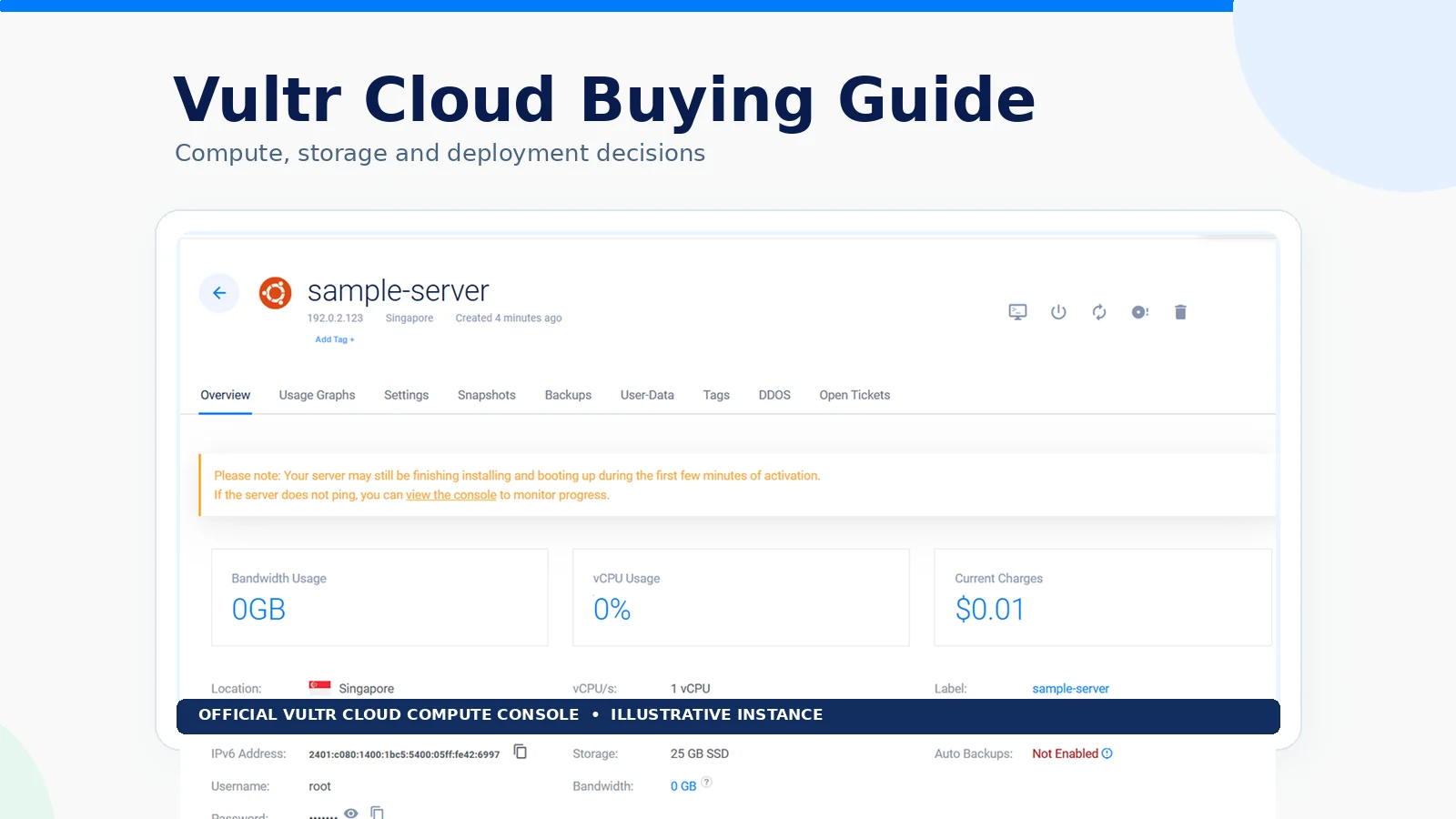
In this guide
Vultr cloud hosting plans cover more than basic VPS servers. The platform offers shared-CPU virtual machines, dedicated-CPU Optimized Cloud Compute, Cloud GPU, Bare Metal and supporting services such as object storage and managed Kubernetes. A small developer site may need only one shared-CPU instance, while a production application with steady CPU demand may justify dedicated resources. The most useful way to shop Vultr is to match the workload first, then compare the full cost of keeping that workload online. A trial credit can offset eligible usage temporarily, but it is not a permanent hosting discount.
What kind of cloud hosting does Vultr actually sell?
Vultr is primarily an infrastructure platform. Instead of one all-inclusive website package, buyers choose compute resources and add the storage, networking and managed services their applications require. You can deploy a machine from an operating-system image and administer it through the Vultr Console, application programming interface (API), command-line tools or Terraform. This flexibility appeals to developers and small teams, but it also creates responsibility for operating-system updates, credentials, firewall configuration, application monitoring and recovery procedures.
For a business owner who wants someone else to maintain WordPress, a managed WordPress host may be an easier alternative. For a developer who wants to control Linux packages, run containers, test application versions or automate deployments, Vultr’s configurable infrastructure is more relevant. Those are different buying goals, not interchangeable hosting products.
Which Vultr Cloud Compute plan fits your workload?
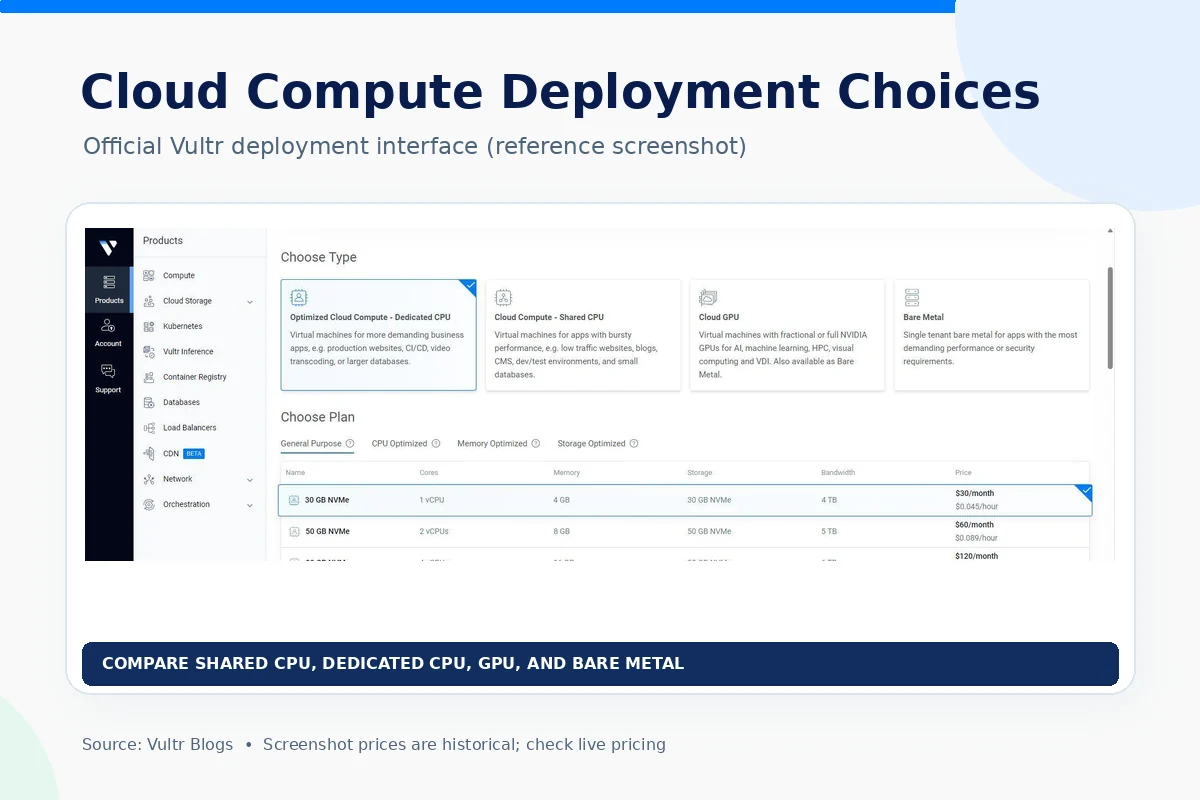
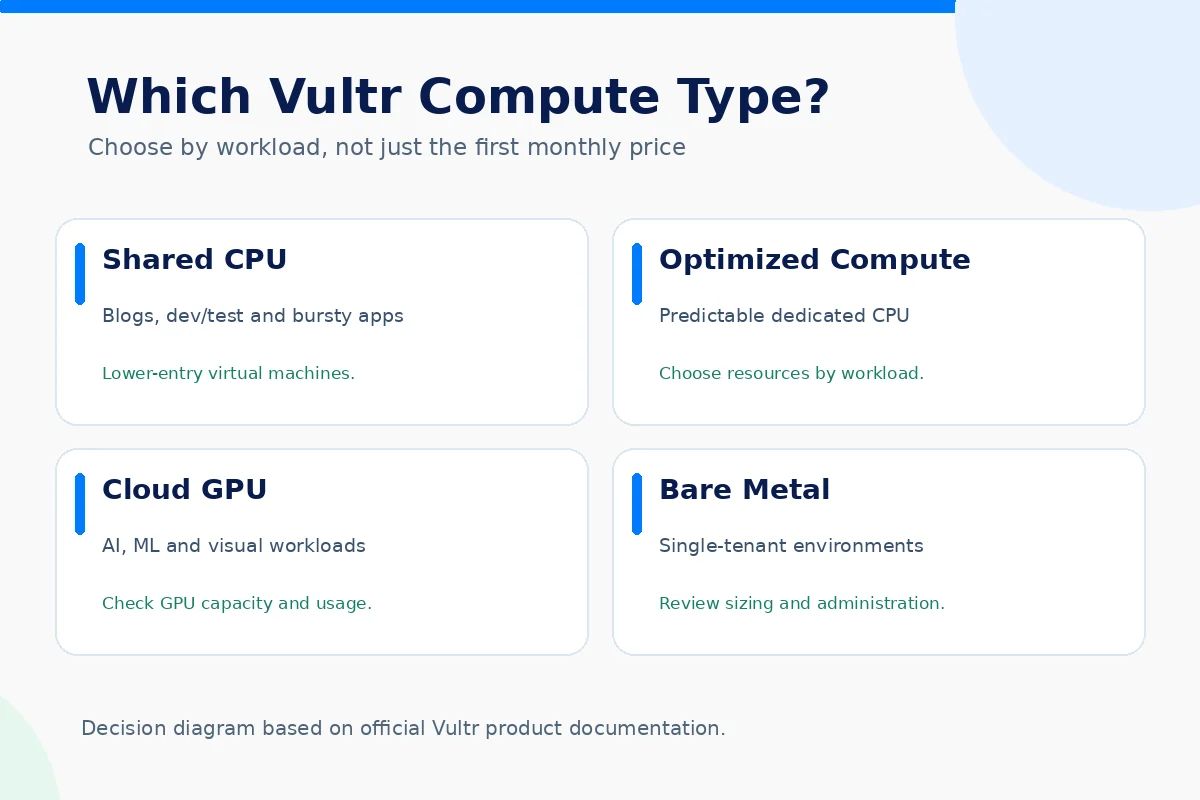
Start by identifying whether the application needs inexpensive burst capacity, consistent processor resources, specialized accelerators or a single-tenant server. The Vultr console exposes several product families, and an attractive entry price should never replace a capacity check.
Shared CPU for prototypes and lighter websites
Vultr Cloud Compute is a shared-CPU virtual-machine option. Vultr describes use cases including blogs, small content-management systems, development environments and smaller applications with variable activity. Its published product overview advertises starting configurations and hourly pricing, but the live price for your particular region and resources is what matters. If you have an occasional traffic spike, validate how the chosen plan handles it rather than assuming that all shared-CPU tiers provide the same sustained throughput.
Optimized Cloud Compute for steadier demand
Optimized Cloud Compute offers dedicated virtual CPUs and plan types oriented toward general-purpose, CPU-, memory- or storage-intensive workloads. It may be the more appropriate starting point for a busy application, persistent background workers or a database-heavy service. Dedicated CPU allocation is a product characteristic, not a guarantee of any particular benchmark result for your code; test performance against your own traffic and application profile.
Cloud GPU or Bare Metal for specialized systems
Cloud GPU products target workloads such as machine learning, visual computing and high-performance computing. GPU model, available memory, software stack and region are critical selection factors. Bare Metal, by contrast, provides a physical single-tenant server and can fit buyers whose architecture requires that deployment model. Neither should be treated as an automatic upgrade for a simple blog; complexity and expenses can exceed the project’s real needs.
How should you compare storage and Kubernetes?
A virtual-machine disk, Block Storage volume and Object Storage subscription solve different problems. Object Storage provides an S3-compatible interface for files, backups and large collections of objects. Compatibility is not identical to implementing every possible Amazon S3 feature, so check the official feature matrix before migrating an application that depends on specific bucket capabilities.
Vultr Kubernetes Engine (VKE) addresses orchestration rather than ordinary one-server hosting. It can help when a team already deploys containerized services and needs node pools, integration with load balancers, persistent storage and cluster-management workflows. Worker-node and associated service charges still matter even when a managed control plane is advertised as included. An organization without Kubernetes expertise may spend more time and money operating a cluster than it saves on infrastructure.
How much will a Vultr project actually cost?
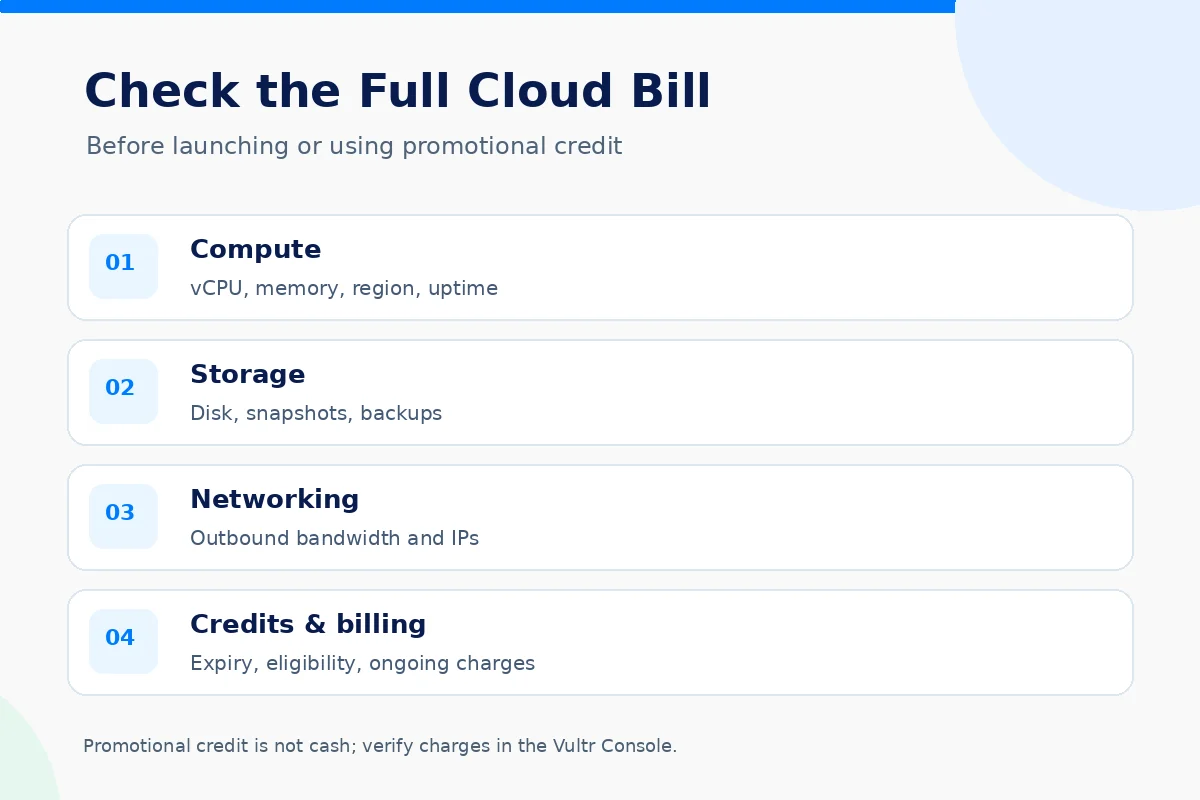
Do not estimate only from the smallest compute-plan card. Model the instance size and the hours it will exist, its data-center region, attached disks, backup retention, outbound traffic, extra IP addresses, load balancing, database resources and any other subscription. A service can look inexpensive at idle and become costly once logs, snapshots or traffic accumulate. For a sensible comparison, calculate the same complete workload on every provider being considered.
A particularly important Vultr billing rule is that stopped instances remain billable. Their allocated CPU, memory, storage and addresses stay reserved. Destroying a server stops its instance resource charges but can permanently erase local data. Make a recoverable backup or snapshot first, check whether that retained snapshot has its own charge, then remove resources you no longer need.
Vultr also distinguishes between hourly billing and product-specific monthly caps. Short experiments and long-running production servers therefore need separate cost calculations; do not multiply a headline hourly rate by an arbitrary month length and assume every server family has identical rules. Confirm the relevant rates and maximums for the selected instance category when budgeting.
What should you know about Vultr promotional credits?
Vultr’s own developer materials have advertised $250 in introductory cloud credits for new accounts and direct users to an official promotional signup page. However, the promotional landing page could not be independently opened during this research, so the offer’s current checkout eligibility and exact restrictions are not confirmed here. Treat it as a potential trial benefit to check on the official signup screen, not a tested coupon code or a universal $250 price reduction.
According to the official promotional-code instructions, the account needs an eligible linked credit card or PayPal method, only one promotional code can be applied per user, and credits expire and are nontransferable. A credit balance should not encourage deploying services you would not otherwise need. Monitor the billed resources and remaining credits, and be prepared for ordinary charges when credits run out or become ineligible.
What should you verify before deploying a production site?
Pick a region with an appropriate latency path to your users and confirm the selected product is available there. Then consider uptime architecture, application backups, access keys, user permissions, firewall and network isolation, monitoring, and a clear rollback plan. A single instance is not the same as a highly available system merely because it runs in a cloud data center.
For migrations, inventory databases, uploaded files, secrets, domain records and any fixed IP dependencies before cutting traffic over. Validate the application on the destination with a test domain or staging environment. If the team is small, document how to patch the system, recover data and dispose of unused resources. These operational tasks usually influence long-term value more than a temporary signup promotion.
Who should choose Vultr, and who should look elsewhere?
Vultr may fit developers comfortable administering virtual machines, agencies building repeatable hosting environments, teams automating cloud infrastructure and projects that benefit from deploying compute near specific users. Dedicated compute and storage choices make the catalog useful across different workloads. It may be less suitable for buyers seeking a completely managed website, a single predictable all-inclusive invoice or infrastructure support that extends to maintaining their application code.
Compare the total ownership effort as well as the bill. If you will spend multiple hours a month administering a simple website, a managed hosting plan may be cheaper overall even when its headline subscription looks higher. Conversely, a technical team may value Vultr’s direct resource configuration, automation and service range more than hand-holding.
Bottom line: how should you buy Vultr?
Choose the smallest type that matches your actual workload and upgrade only with evidence from monitoring. Use shared CPU for modest or experimental projects, evaluate dedicated CPU for sustained work, and reserve GPU or Bare Metal for genuine specialized requirements. Add Kubernetes and storage products only when the architecture needs them. Always check billing for stopped resources, the consequences of destroying instances, refund terms and credit eligibility. A good Vultr purchase starts with a resource plan and an exit plan—not just a promotional number.
Research disclosure: This independent guide uses Vultr’s official product and billing documentation reviewed on November 15, 2026. We did not deploy, benchmark, pay for or test Vultr services or redeem a promotional code. Product availability, prices and credit eligibility should be confirmed at checkout. Vultr has not endorsed CouponF5.