CouponF5 is an independent publisher. We may earn a commission when you purchase through our links, at no extra cost to you. Merchant terms apply.

In this guide

Hawk Host
Hawk Host Turbo Shared Web Hosting — Black Friday 2026
Black Friday 2026: Turbo hosting from $5.88/mo equivalent on a 12-month prepaid term ($70.51 due upfront). 1-, 2- and 3-year options, 70GB NVMe, 4…
Hawk Host Cloud VPS hosting is a practical option for people who need a virtual server with full root access, adjustable CPU and memory allocations, and a choice of international deployment locations. But a VPS is not simply a faster version of shared web hosting: you gain control of the operating system and application stack while taking on more system administration. Before buying, compare the resource tier, bandwidth allowance, software licenses, ongoing cost, and Hawk Host’s exact support scope.
What does Hawk Host Cloud VPS include?
The official VPS page describes scalable virtual machines with full root access, NVMe-backed storage, a 1 Gbps network port, and bandwidth allowances that rise with the selected RAM tier. Its technical documentation identifies KVM virtualization on a StorPool-powered cloud platform. That means a separate virtual operating-system environment rather than a conventional shared-hosting account with only a user-level control panel.
The product page allows you to choose a region, then compare monthly and one-year billing. Listed locations include Los Angeles, Dallas and New York in the United States, plus Toronto, London, Singapore and Hong Kong. Location is a material buying decision: an application serving mainly US users may benefit from locating near its customers, but the best region depends on network routing, data handling requirements and the audiences you serve. Test actual latency rather than assuming the closest city always delivers the best experience.
Which VPS size should you consider?
Hawk Host lists seven RAM-based capacities. The published examples include 1GB with one CPU core and 30GB NVMe, 2GB with one core and 55GB, 4GB with two cores and 85GB, 8GB with four cores and 165GB, 16GB with six cores and 325GB, 32GB with eight cores and 650GB, and 64GB with 16 cores and 1,300GB. The corresponding published bandwidth allowances range from 2TB to 20TB. Those figures describe allocated resources; they are not proof of benchmark speed, request throughput or an uptime level.
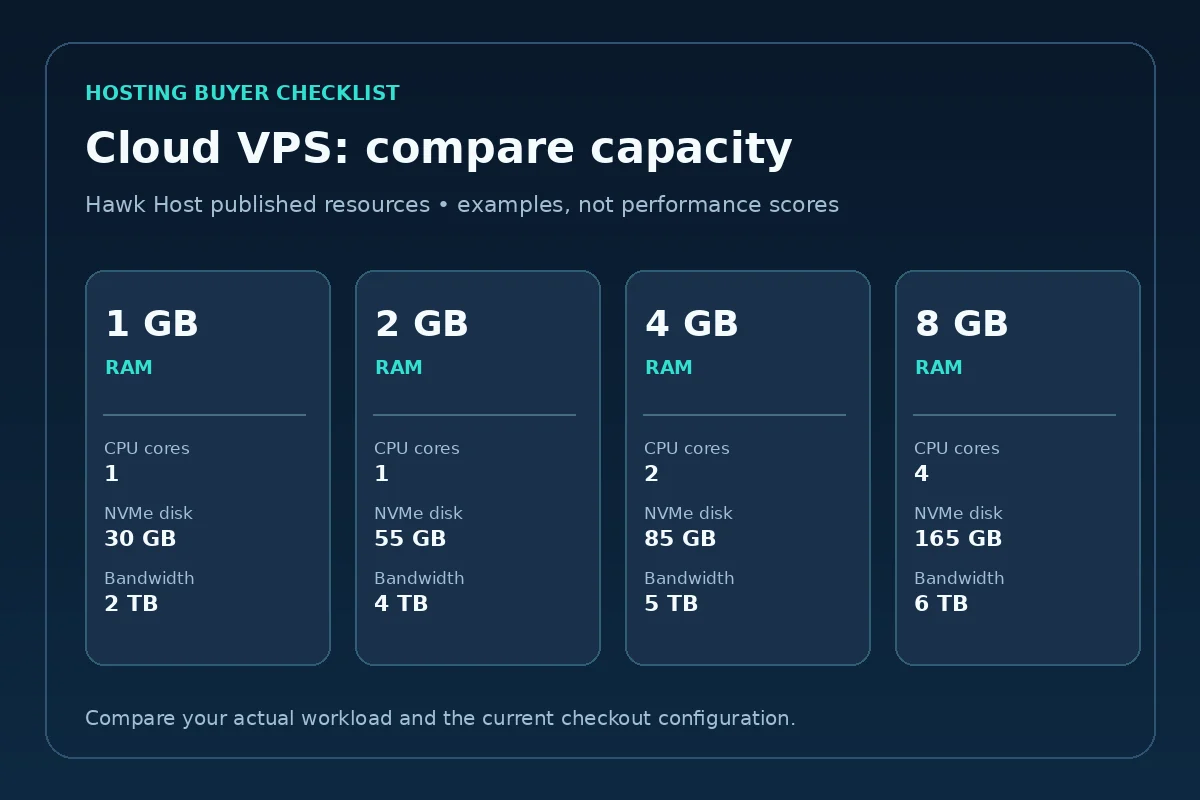
1GB and 2GB: Consider these for low-traffic development machines, a small service or a light application whose actual memory consumption is known. A 1GB server may be too constrained for a graphical control panel, multiple databases, a large web application or several containers. Check the operating system, swap behavior and peak memory use before selecting the smallest tier.
4GB and 8GB: These are more useful starting points for developers operating several services, a database-backed app, or production workloads with moderate concurrency. The step up in CPU cores and NVMe capacity can provide room for growth, but it still does not replace profiling an inefficient app or testing backup recovery.
16GB through 64GB: Higher tiers can suit memory-intensive workloads, more demanding application environments and multiple services. As the VPS bill grows, compare the price against alternative compute platforms, managed VPS plans and your own engineering time. A larger allocation should be a response to measured demand, not a substitute for architecture planning.
How much does Hawk Host VPS hosting cost?
The merchant presents two billing choices: monthly and a one-year commitment. A recent official listing advertises entry-level VPS pricing starting from approximately $6 per month on monthly billing or $5 per month equivalent on a one-year term for a 1GB configuration. An older crawl of the same official page displayed a lower $5 monthly/$4.17 annual-equivalent pairing. That difference shows why an indexed price is not enough to establish your actual checkout quote. The displayed amount can depend on the selected region, billing period or promotion.
Use the one-year equivalent price only as a comparison tool. A $5 monthly equivalent on an annual contract implies roughly $60 over 12 months, not a $5 month-to-month invoice. If a promotional first-year price applies, record the total due now and the normal renewal charge separately. The official November 23 Black Friday Week announcement also lists a temporary Cloud VPS first-year offer through November 30, 2026. It should not be treated as the permanent VPS rate or assumed to apply to later renewals.
Potential software licensing changes the total cost. cPanel/WHM, DirectAdmin and other management panels appear as selectable products or separate licenses rather than being included automatically with the base virtual server. Similarly, premium web-server software and additional tools can carry fees. Compare server + panel + backups + support + security + expected renewal, not just the headline compute price.
Is Hawk Host Cloud VPS managed or unmanaged?
Hawk Host’s own comparison article calls its Cloud VPS offering semi-managed. The host helps with critical system-level issues such as a virtual machine failing to boot or core services not starting. It explicitly does not extend this support to individual websites, custom application software or code debugging. The server starts with a base operating-system installation; tools such as cPanel/WHM and DirectAdmin must be installed or licensed separately if needed.
For a buyer, this support boundary may matter more than the number of CPU cores. Expect to plan for operating-system updates, firewall rules, SSH access protection, software patching, monitoring, database tuning and application recovery. If your business cannot provide that expertise, a managed hosting service or external administrator may be the more economical choice even if its sticker price is higher.
Cloud VPS vs. semi-dedicated hosting
With Hawk Host semi-dedicated hosting, the provider handles the hosting server environment and bundles a familiar cPanel web-hosting stack. Cloud VPS supplies root control inside a KVM-based instance, with greater freedom to choose system software and configure network services, but more direct administration responsibility. The merchant says its semi-dedicated packages include certain integrated tools such as LiteSpeed, Acronis backups and malware protection that are not automatically part of Cloud VPS.
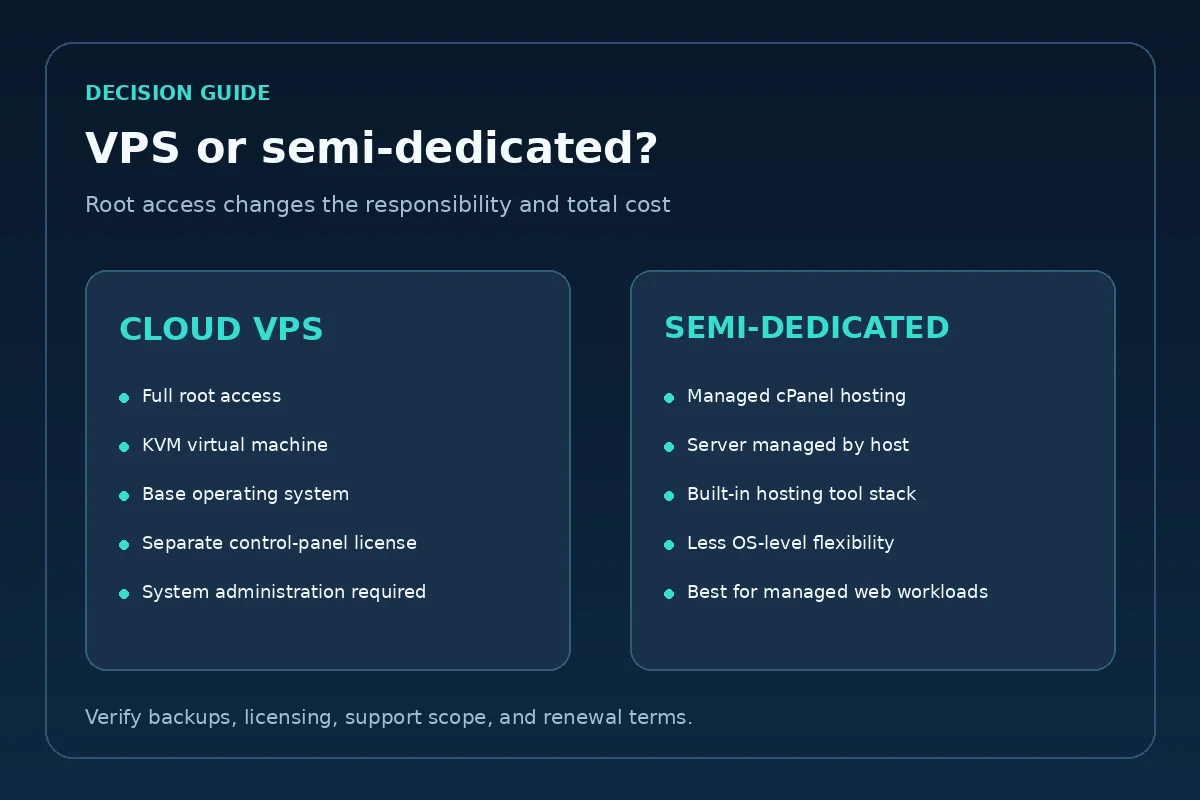
Choose semi-dedicated when your primary goal is more resources for a conventional website and you prefer a fully managed account. Choose Cloud VPS when you need root-level access, custom services, nonstandard runtime configurations, or your own server-management policies. If you run WordPress and do not want to manage Linux, do not assume a raw VPS automatically provides the same ease of use as managed WordPress or cPanel hosting.
What about backups, security and server locations?
Ask what backup services are enabled on your specific VPS order and how restoration works. A generic backup policy for shared cPanel accounts is not proof that every Cloud VPS automatically receives the same backup coverage. The merchant’s support materials distinguish VPS services from some shared-account retention practices. Keep independent off-server backups of critical data and rehearse restoration to a test environment before trusting a production deployment.
With root access, you control privileged accounts, operating-system security updates and which services accept connections. Use SSH keys, restrict administrative access, apply least-privilege permissions, and monitor disk, CPU, memory and network transfer. For application availability, set up external health monitoring and alerting. If you send mail directly, check the provider’s outbound mail and port restrictions first rather than discovering them after deployment.
Hawk Host lists seven international data-center locations. Choose based on real users, compliance needs and where other dependent services are hosted. Latency to a US audience, privacy obligations and cross-region backup strategy may lead to different choices. The location selector on the merchant’s page should be treated as the final reference for current availability.
A practical pre-purchase checklist
- Define the workload: Document its minimum and peak RAM, CPU, disk space, bandwidth and expected traffic.
- Choose a region: Favor measured application latency, suitable data location and proximity to major users.
- Select your billing term: Compare the amount paid now, renewal cost and any first-year-only promotion.
- Add license fees: Determine whether you actually need cPanel, DirectAdmin or other paid server software.
- Plan administration: Decide who maintains the operating system, security, monitoring and application stack.
- Verify backup scope: Confirm snapshots, retention and restores for your exact Cloud VPS product, and maintain a separate backup.
- Read the support boundary: Know which incident types the provider handles and which your team must resolve.
Bottom line: is Hawk Host Cloud VPS the right choice?
Hawk Host Cloud VPS is most appealing to technically comfortable users who value root access, KVM-based infrastructure and the flexibility to select a server size and geographic region. It is less compelling if you want a host to run every aspect of WordPress, debug your custom code or maintain your system without additional management. Start from a realistic resource budget, include software licenses and backups, and confirm the total first invoice and renewal terms at checkout.
For current configurations and ordering, consult the official Cloud VPS Hosting page. This article is based on published Hawk Host documentation as of November 28, 2026. It is not a hands-on server benchmark, an uptime measurement or a completed purchase.
Hawk Host
Hawk Host Turbo Shared Web Hosting — Black Friday 2026
Black Friday 2026: Turbo hosting from $5.88/mo equivalent on a 12-month prepaid term ($70.51 due upfront). 1-, 2- and 3-year options, 70GB NVMe, 4…