CouponF5 is an independent publisher. We may earn a commission when you purchase through our links, at no extra cost to you. Merchant terms apply.

In this guide
Namecheap domain and hosting services can be purchased together, but they solve different problems. Register a domain when you need control of an internet address; buy hosting only when you need a place to run a website or application. Namecheap offers conventional shared hosting, managed WordPress via EasyWP, and more configurable server options, along with email and website tools. For US shoppers, the sensible approach is to choose the website workflow first, then compare the full registration, hosting and renewal costs instead of buying the largest introductory discount.
Should you buy your domain before choosing a hosting plan?
Often, yes. Your domain is the address visitors type; your hosting service stores or runs the site they reach. A registrar can manage DNS records that point to another host, so you do not need to commit to Namecheap hosting just to secure an available name. If you are still choosing a platform, keeping the domain decision separate can prevent unnecessary spending on a hosting plan you do not use.
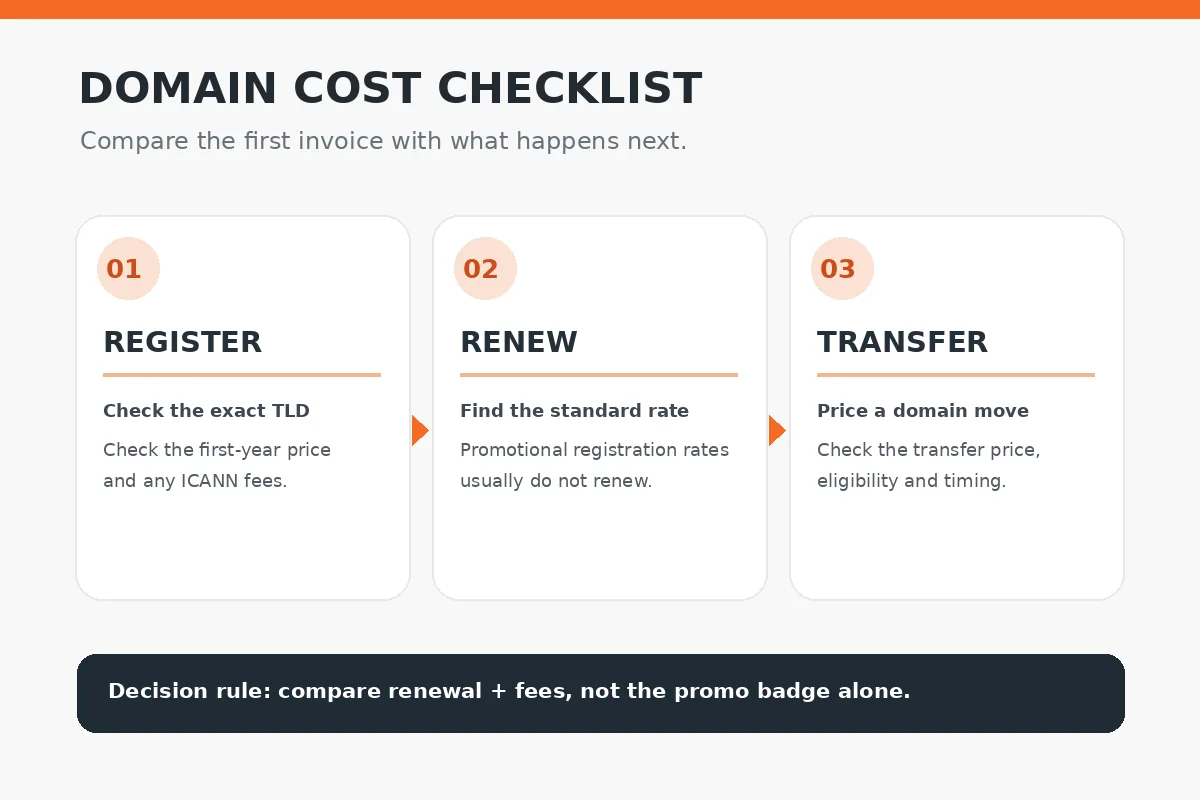
Start by checking the exact extension, spelling and trademark implications, and then compare registration, renewal and transfer terms. A .com and a .net are not interchangeable from a branding standpoint, and their first-year promotions can differ considerably. If you are moving a domain from another registrar, check its transfer eligibility, lock status, expiration and DNS continuity rather than assuming a transfer acts like a new registration.
How do Namecheap domain discounts affect the longer-term bill?
Namecheap has advertised code NEWCOM648 for an eligible new customer’s .com registration at $6.48 for the first year. Its November 1, 2026 price notice lists the standard .com renewal at $19.98 per year before any applicable ICANN fee. These are different transaction types and should not be presented as a permanently discounted domain. You can confirm the published change in Namecheap’s official .com price notice.
Here is a planning example using those currently published figures: one promotional first year at $6.48 plus two hypothetical renewals at $19.98 would total $46.44 over three years, excluding fees, taxes and optional services. This is not a guarantee of future renewal prices or a claim that the coupon will remain available. The purpose is to compare lifetime cost on a consistent basis, not to treat the headline percentage as the final saving.
Another question is privacy. Namecheap’s free Whois privacy can be added automatically to eligible registered or transferred domains. It is not available for every TLD because some registries restrict privacy services. If the privacy feature matters to you, verify eligibility for the particular extension before checkout rather than treating it as a universal inclusion.
Which Namecheap website product should you choose?
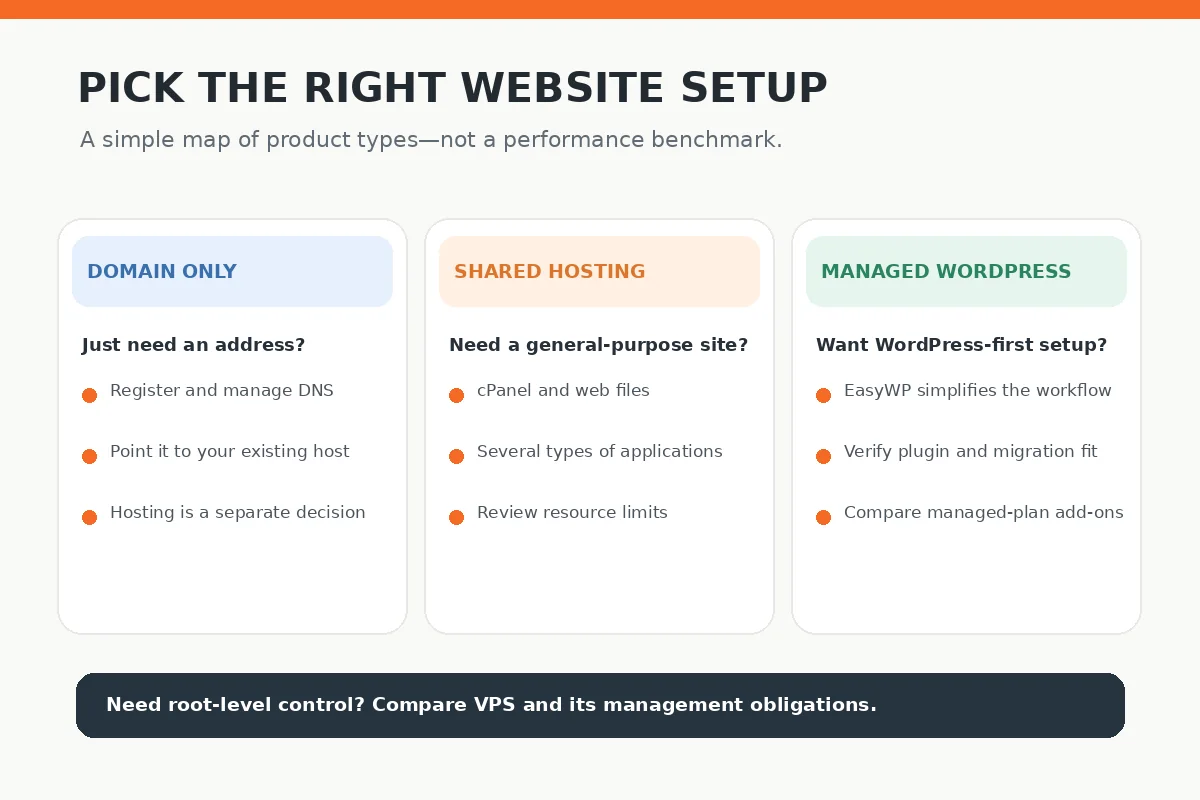
Buying a domain does not automatically create a live website. Choose the site platform separately. Namecheap’s main paths differ in who manages the software and how much control the buyer needs.
Shared Hosting: flexible setup with cPanel
Namecheap’s Stellar shared-hosting plans include the familiar cPanel environment and installation tools for WordPress and other applications. The current plan descriptions distinguish website allowances, storage and backup features. Shared hosting can be reasonable for a blog, small business website or other conventional site, but accounts share underlying server resources and users are still responsible for their application choices. Check plan-specific storage, mailbox limits and backups before deciding.
EasyWP: managed WordPress without a conventional cPanel workflow
EasyWP Starter, Turbo and Supersonic focus on WordPress sites. This is a useful route if you specifically want WordPress and value a managed setup process over the broader flexibility of a traditional hosting account. Starter is positioned for a first site; higher tiers add resources and other benefits. Review caching and plugin compatibility, the number of WordPress sites, the actual renewal price and whether the included domain or email benefits apply to your selected tier. Marketing descriptions are not independent speed benchmarks.
Site Maker: a simpler design-first website
Site Maker is built around visual editing for personal and business presentation websites. Namecheap currently advertises a 14-day trial, with fees after the trial depending on which version you select. Importantly, Namecheap’s Site Maker FAQ says it is not intended for eCommerce sites. A store requiring payments and a product catalog needs another suitable platform.
VPS and dedicated servers: for more control
Developers and resource-intensive projects can assess Namecheap VPS or dedicated-server products. These are not simply upgraded shared plans: configuration flexibility and administrative responsibilities are different. Compare root access, server management level, backups, technical support, and how much of the infrastructure your team can maintain. A simple brochure website rarely needs dedicated hardware.
Should you also buy email, SSL or security products?
A custom email address can improve business continuity and brand consistency, but it is separate from domain registration and may also be separate from a hosting plan’s included mailboxes. Namecheap’s Private Email has Launch, Expand and Scale levels. Its official email page describes a 30-day trial for eligible accounts and a distinct MAILDEAL discount on certain paid yearly or two-year terms. A free trial is not the same as a reduced paid-plan purchase, and those benefits should not be assumed to combine.
For website security, understand what your chosen plan already includes before adding a paid certificate or extra protection. Shared Hosting and EasyWP offer SSL-related features, but deployment and third-party domain eligibility can differ. If using a website builder, check whether its SSL and hosting are part of the builder subscription. The same principle applies to paid DNS, backups and malware tools: avoid overlapping subscriptions.
What do Namecheap’s refund and renewal rules mean?
The renewal calculation can matter more than the first invoice for a project intended to stay online. Record the domain’s regular renewal, hosting price after the promotion, email subscription after a trial, any optional licenses, and whether your cart has auto-renewal enabled. Use the same one-, two- or three-year horizon when comparing another provider.
Namecheap’s published refund policy distinguishes domain purchases from hosting services. Domain registrations and renewals are generally final, although some new registrations may be eligible for case-by-case cancellation requests within five days. Eligible first-time Shared, Reseller and VPS hosting packages may qualify for refunds within 30 days; dedicated servers have a shorter first-purchase window. Software licenses and other products can have exclusions. Always check the precise service’s current rules before paying.
A five-minute pre-checkout checklist
- Identify the job: domain only, traditional website hosting, managed WordPress, a no-code website or a custom server.
- Price the full path: first-year registration, ordinary renewal, hosting term, future hosting renewal and paid extras.
- Check the restrictions: trial eligibility, new-customer code conditions, included domain extensions, and whether the offers stack.
- Verify ownership and recovery: access to registrar controls, DNS, backups, email, and a clear process to leave or transfer later.
- Record the terms: save the confirmation, renewal schedule, cancellation route and applicable refund policy.
Is Namecheap a good fit for your project?
Namecheap makes practical sense for buyers who want flexible domain management and the option to add hosting, WordPress, email or website tools without moving between several storefronts. Start with a domain if you have not selected a website platform yet; choose Shared Hosting for a traditional cPanel workflow, EasyWP for a WordPress-specific approach, and Site Maker for a simpler non-store website. Compare an outside specialist if your priority is advanced managed infrastructure or a very specific technical requirement.
The key drawback is that the Namecheap name appears on very different products with different fees, refund terms and responsibilities. A low first-year price does not determine the right long-term choice. This independent guide is based on publicly documented merchant terms; no hosting account, checkout redemption, migration or performance test was performed.