
CouponF5 is an independent publisher. We may earn a commission when you purchase through our links, at no extra cost to you. Merchant terms apply.

In this guide
Neither Cyber Monday nor Black Friday is automatically better for savings. Compare the exact same product, eligible promotions, complete checkout totals, delivery dates and return terms. A sale’s name or the size of its advertised discount cannot tell you which transaction provides more value.
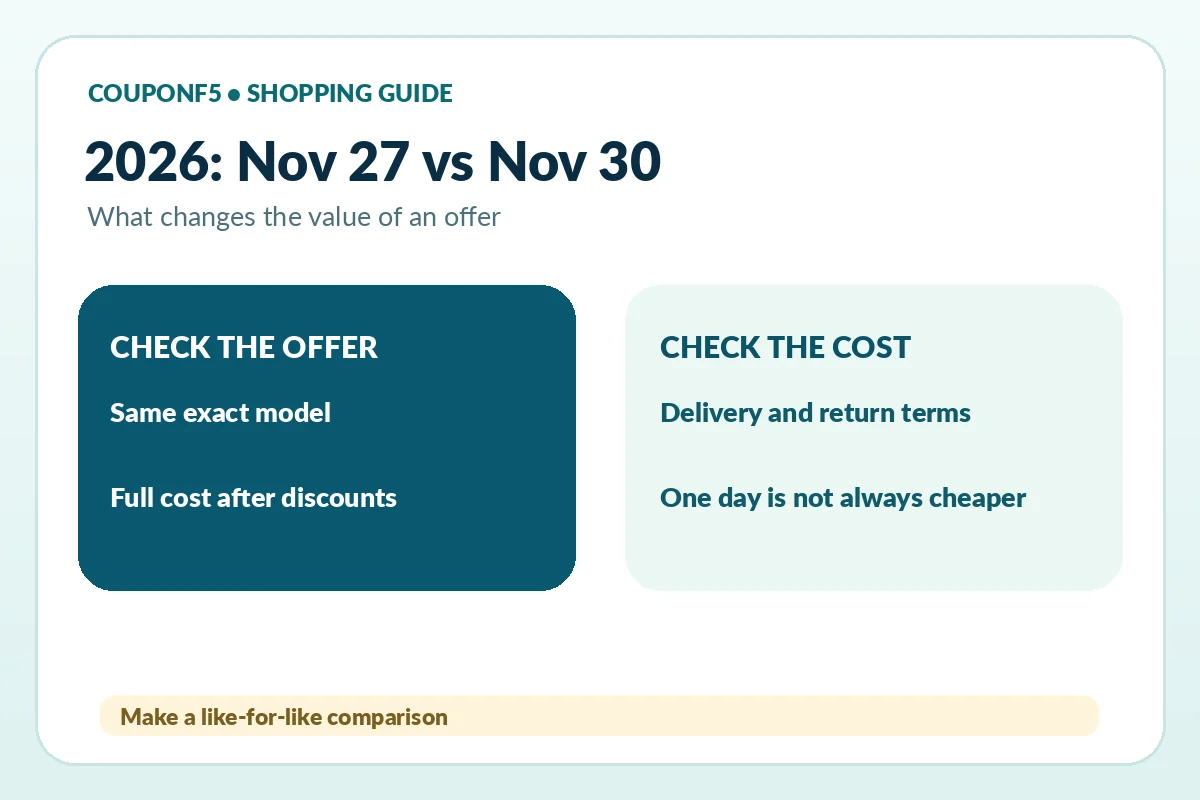
In 2026, Black Friday is Friday, November 27, and Cyber Monday is Monday, November 30. Merchants can start campaigns before those dates or continue discounts across the weekend. The right decision depends on an actual offer, not a general claim that one shopping day always wins.
What Changes From Friday to Monday?
Black Friday follows US Thanksgiving, and Cyber Monday follows on the next Monday. Both events now have online promotions, so the old distinction between in-store Friday sales and internet-only Monday offers is not a reliable way to predict prices.
One retailer might repeat the same discount on both days while another changes its selection, bundle or coupon conditions. A third may run a continuous promotion. Treat each advertised deal as a specific offer with its own products, dates, redemption limits and delivery terms.
1. Compare the Exact Model and Bundle
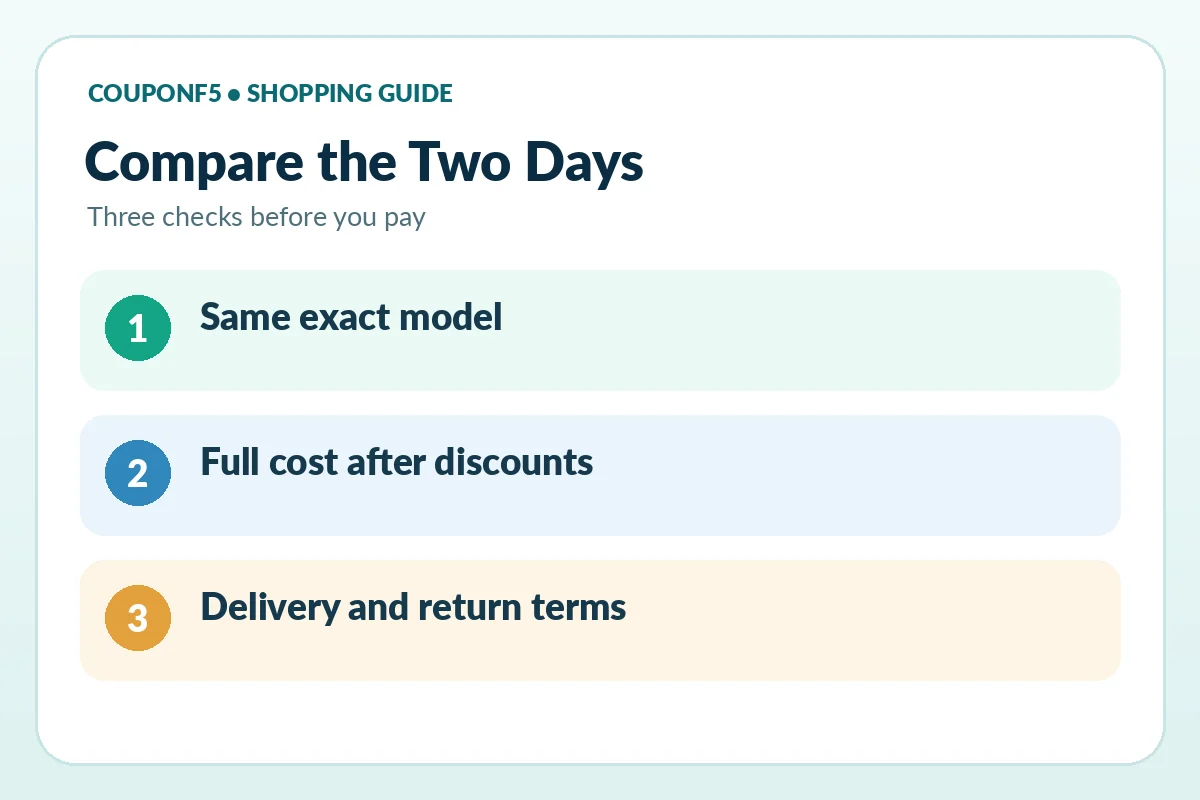
Start with the product number, color, size, storage configuration, condition and included accessories. An electronics bundle offered Friday may contain a case or charger absent from a Monday listing. A discounted apparel product may not be available in the required size two days later.
Without matching items, a comparison based solely on price is misleading. List any meaningful differences and their value to you. A lower total for a less suitable product does not establish a better purchase.
2. Calculate the Full Checkout Total on Each Day
For a hypothetical identical item, imagine a Friday product price of $94 after an eligible code plus $8 shipping. The total before tax is $102. On Monday the same item is $99 with free delivery, or $99 before tax. In this example Monday saves $3, assuming the same service and no other charges.
Another item might favor Friday. Taxes can vary by purchase details, so compare the actual payable totals rather than relying only on illustrative arithmetic. Do not compare one retailer’s pretax product subtotal with another’s final payment amount.
3. Check Which Codes and Automatic Deals Apply
Some sales require entering a promo code, while others automatically reduce eligible items. Coupons may exclude clearance or selected models, require a qualifying amount, or be reserved for certain accounts. The same percentage can produce different dollar savings when eligible products vary.
If you encounter cashback or loyalty rewards, distinguish them from a discount that immediately lowers the price. A future cashback reward may require tracking and redemption, while an instant coupon appears in the order summary. Do not double-count a reward as if it were already deducted.
4. Compare What You Risk by Waiting
For a flexible purchase, you may decide to observe how offers change. But a desired model or size could sell out, and no store is obligated to offer a lower price Monday. If you need the item by a fixed date, delaying for an uncertain promotion can be costly even if a future price looks appealing.
If a credible Friday price meets your budget and delivery needs, buying then can be sensible. If the purchase is optional and current prices are not attractive, waiting can also be sensible. Neither strategy guarantees the cheapest outcome.
5. Evaluate Delivery Speed and Availability
Confirm whether the item is in stock, when it is expected to ship, and which delivery method the offer covers. A free-shipping Monday promotion might use standard delivery, while a paid faster Friday shipment could better meet your needs.
If the order is intended as a gift, review merchant-specific arrival estimates. Do not infer a holiday delivery guarantee from the label “Cyber Monday” or “Black Friday.” Sellers and carriers set the actual timing.
6. Read Return and Refund Conditions
Check the retailer’s return window, whether discounted merchandise is final sale, and who pays return postage. Some merchants use different policies for clearance, seasonal bundles or promotional goods. The cheapest advertised item may have less convenient return terms.
The FTC recommends reviewing delivery, return and refund policies while comparing online purchases. Apply the same standard on both sale days instead of focusing only on the coupon line.
7. Verify Seller Credibility
A surprising holiday price from an unfamiliar site can be a reason to research the seller, not a reason to rush. Open the official domain independently, read its contact and policy information, and review credible customer experiences from more than one source.
Do not enter payment credentials on a strange coupon page or download unknown software to reveal a deal. A counterfeit product, missing shipment or inaccessible seller can wipe out the apparent savings from a low price.
8. Be Careful With Reference Prices
A banner that claims “40% off” may compare the offer with a high reference price rather than a price you would realistically pay elsewhere. Compare the exact item’s current market price. If another trusted seller has the same model for less, a larger displayed percentage does not make the more expensive offer preferable.
Track the full after-discount price of the specific model across both dates. Avoid assuming that a higher list price is evidence of a more valuable bargain.
A Friday-versus-Monday Scorecard
| Factor | What to record on both days |
|---|---|
| Product match | Model, size, condition and included accessories |
| Eligible discount | Actual coupon or automatic price reduction |
| Total payment | Items, delivery, fees and tax |
| Fulfillment | Stock, shipping speed and expected delivery |
| Return terms | Window, refund type and return postage |
Four Steps to a Better Choice
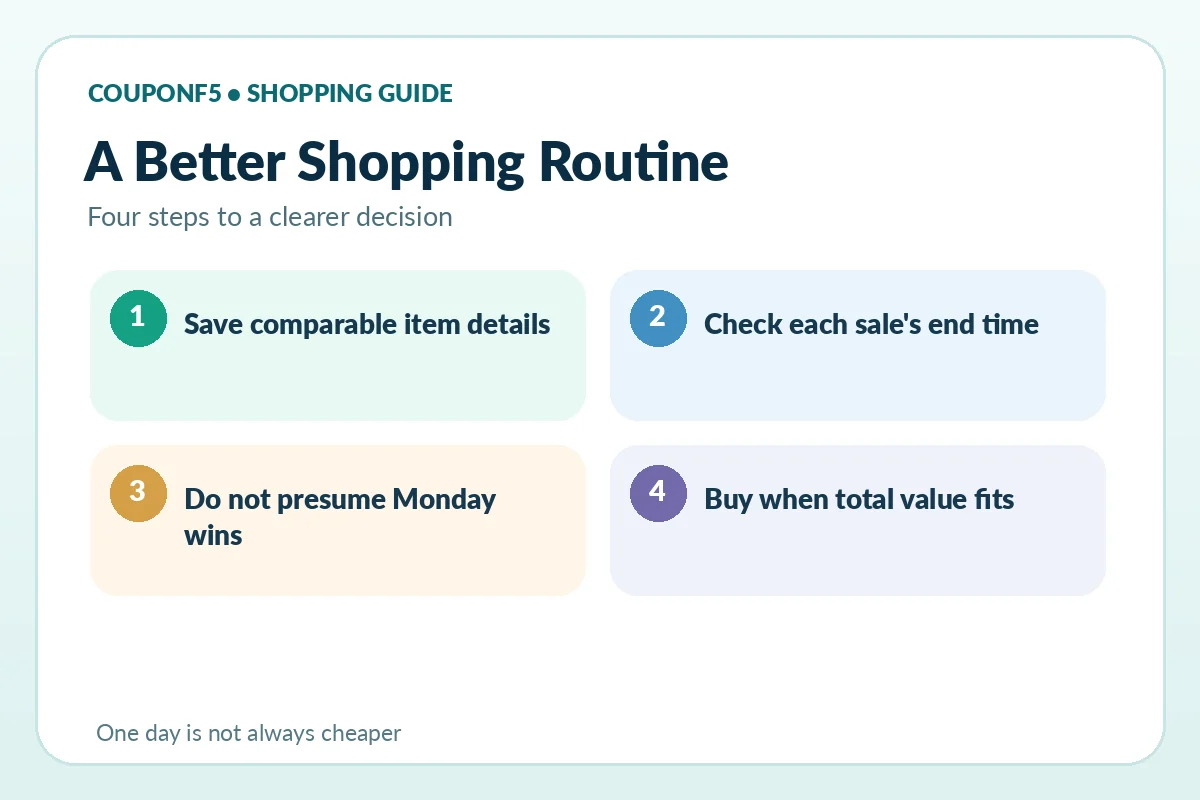
- Record the same exact model and your maximum all-in price.
- Compare Friday and Monday offers only when your cart qualifies.
- Check delivery, seller credibility, return rules and stock.
- Use the lower realistic total that meets your needs rather than presuming one event wins.
Frequently Asked Questions
When is Cyber Monday 2026?
Monday, November 30, 2026, after Black Friday on November 27.
Are electronics always cheaper on Cyber Monday?
No. Actual prices vary by model, retailer, eligibility and inventory.
Should I always wait until Monday?
Not necessarily. You could lose a suitable in-stock Friday option, and Monday is not guaranteed to be cheaper.
Can I use a Black Friday coupon on Cyber Monday?
Only if the retailer’s stated validity period and product rules allow it.
The Bottom Line
Compare like-for-like offers using full costs and practical terms. Either day can win for a specific purchase, and neither guarantees better savings across all stores.