
CouponF5 is an independent publisher. We may earn a commission when you purchase through our links, at no extra cost to you. Merchant terms apply.
In this guide
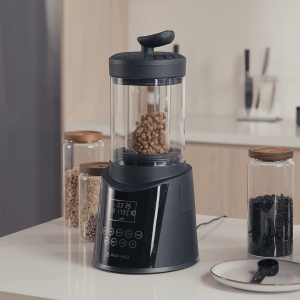
Mago Maga
Roma Pro V1.6 Home Coffee Roaster
Home green-coffee roasting appliance with adjustable roasting controls.
The best coffee roaster machine for a small business is the one that can produce your weekly coffee demand consistently, in a space that can legally and safely support its power, ventilation and maintenance needs. A compact 1 kg roaster may work for product development and very small runs; a 2–3 kg unit can suit a café or emerging brand; a 5–6 kg class machine may be more practical as wholesale volume rises. These are planning ranges, not universal sales thresholds.
Start with the amount of roasted coffee you expect to sell, then calculate the green coffee input, available roasting hours and realistic batch loads. Only after that should you compare equipment prices. This guide covers current manufacturer-listed examples and installation considerations for US operators as of November 12, 2026. We have not purchased or hands-on tested these machines.
Quick answer: which size should a small business consider?
| Business situation | Size worth evaluating | Watch out for |
|---|---|---|
| Learning, recipe development, very small sales runs | About 1 kg per green-coffee batch | Many batches and extra labor as orders increase |
| Small café, farmers’ market or young online brand | About 2–3 kg | Electrical or gas installation, venting, cool-down and packaging hours |
| Growing subscriptions or multiple wholesale customers | About 5–6 kg | Higher total installed cost, building approvals and limited room for layout mistakes |
Our buying rule: Compare what each machine reliably produces per working week, not just its advertised maximum batch size. Two machines with a similar nominal capacity may differ in cycle time, minimum load, cooling workflow, fuel requirements and how quickly the operator can repeat a roast.
1. Calculate roasting capacity before comparing brands
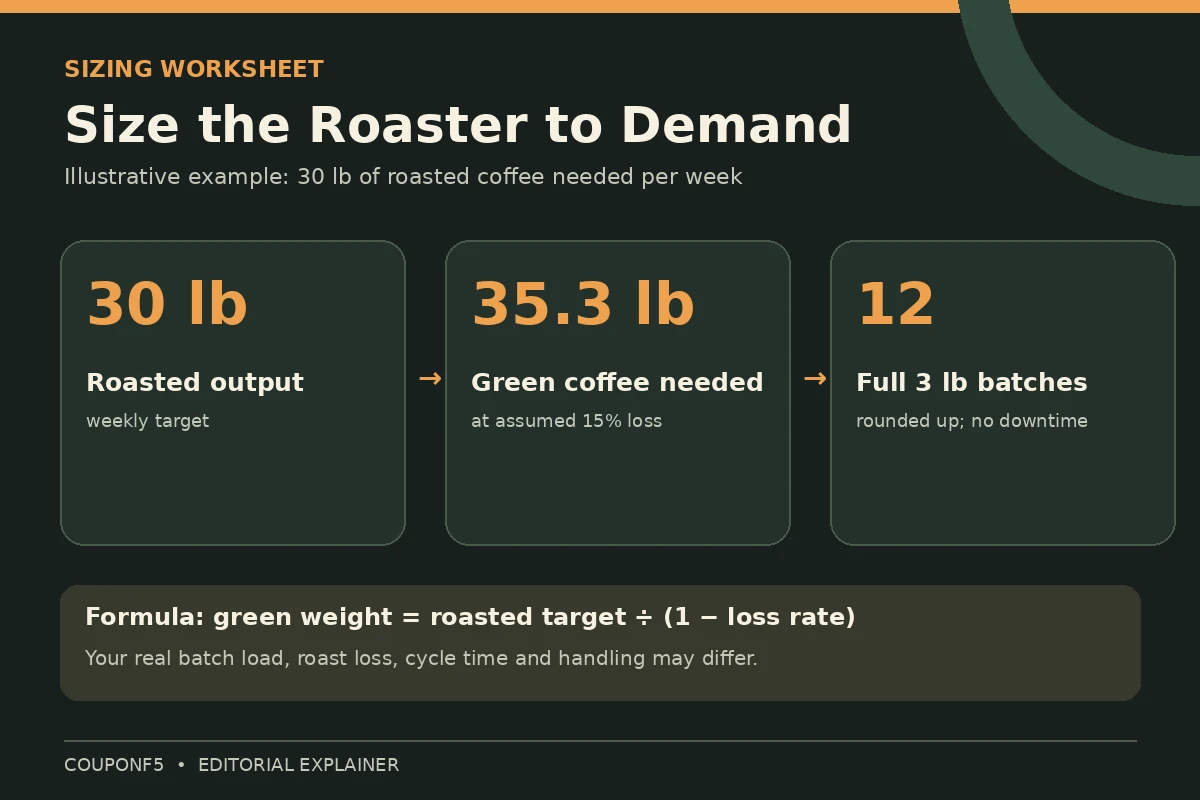
Roasted beans weigh less than the green coffee loaded into a machine. The exact loss depends on the coffee and roast profile; for preliminary planning, we can illustrate a 15% loss assumption. It is not a guaranteed value for every coffee. A useful calculation is:
Required green coffee (lb) = target roasted coffee (lb) ÷ (1 − estimated roast loss).
For a hypothetical business selling 30 lb of roasted coffee each week, 30 ÷ 0.85 = 35.3 lb of green coffee. On a machine that can genuinely take 3 lb of green coffee per batch, that is at least 12 full batches per week before adding extra batches for roast variations, production losses, cupping or inventory buffer. Smaller actual loads will require more batches.
Next, build a real schedule. Allow for warm-up, loading, roasting, cooling, chaff removal, cleaning, weighing, packaging, labeling and order fulfillment. Ask the manufacturer to demonstrate repeatable production at your intended roast style and batch weight—not merely its fastest published hour.
Three questions that change the capacity calculation
- What does the capacity figure describe? Green-bean batch load, finished-roast yield and advertised hourly output are different measurements.
- Can you run your smallest product batch well? A machine with a 6 kg maximum may be unsuitable for very small single-origin lots if its minimum practical charge is high.
- Who operates the roaster? One employee handling roasting, packaging and café service cannot devote the entire shift to uninterrupted batches.
2. Small-business coffee roaster machines worth comparing
The examples below span distinct business stages; they are not a laboratory-tested performance ranking. Specifications and listed prices are drawn from the manufacturers’ public pages and should be reconfirmed with a written quote before purchase.
| Model | Manufacturer-listed batch size | Likely fit | Important requirement |
|---|---|---|---|
| Aillio Bullet R2 | 150–1,000 g | Small specialty batches, learning and profile development | R2 variants have specified 120 V or 200–240 V configurations; confirm the exact unit |
| Coffee Crafters Valenta 3 Base | 200 g–3 lb | Entry commercial production using a fluid-bed approach | Manufacturer lists single-phase 240 V, 30 A for the Base model |
| Mill City MCR-2E | Up to 2 kg | Small production needing digital controls and repeatability features | Dedicated 230 V, 23 A circuit plus specified outdoor exhaust |
| Diedrich IR-5 | 5 kg | Established café roastery or expanding wholesale operation | Request current gas, venting and site-specific installation specifications |
| PROBAT P05 | 1–6 kg | Business seeking wider batch flexibility and production headroom | Compare available heating configurations and total site preparation |
Compact option: Aillio Bullet R2
Aillio specifies a 150 g–1,000 g range for the Bullet R2, with induction heating and software connectivity. The R2 Pro is a separate 150 g–1,200 g machine requiring 200–240 V; do not assume that a US standard 120 V outlet works with the Pro. The practical advantage of a compact machine is a manageable batch for testing origins or developing profiles. The trade-off is labor: many small batches are required to supply a meaningful weekly retail volume. Confirm commercial suitability, venting, warranty and electrical requirements with the seller and local officials.
Entry commercial fluid-bed option: Coffee Crafters Valenta 3
The Valenta 3 Base uses heated airflow and has a published 200 g–3 lb batch range. The manufacturer’s listed Base price starts at $4,800, with configurations and accessories affecting the final amount. Its Deluxe version lists up to 21 lb per hour and different blower/electrical requirements; that figure is the manufacturer’s advertised capability, not our measured yield. Compare the actual bundle, cooler, blower, ducting and automation options, rather than treating the lowest machine price as an installed price.
Small production drum option: Mill City MCR-2E
Mill City’s MCR-2E lists a 2 kg maximum, digital logging/automation-ready controls, separate cooling airflow and a manufacturer-listed price of $19,500. The company specifies a dedicated 230 V/23 A circuit and outdoor exhaust, so this is not a standard countertop appliance. Its price should be evaluated alongside the value of the controls, service access, ventilation planning and the production workflow you need.
Scaling options: Diedrich IR-5 and PROBAT P05
Diedrich’s IR-5 documentation lists an 11 lb (5 kg) batch and approximately 18 kg/hour maximum output. PROBAT’s P05 specifications state a 1–6 kg batch range and an indicative 17 kg/hour capacity, with gas and electric configurations. These hourly numbers come from different manufacturers and are not a controlled head-to-head comparison. Larger systems deserve a facility plan and realistic product forecast before a purchase commitment.
3. Drum vs fluid-bed: which roasting method should you choose?
A drum roaster rotates beans in a heated chamber. A fluid-bed machine uses heated moving air to suspend or agitate the beans. Both can make excellent coffee when properly operated. Neither mechanism alone proves a cup will taste better, nor does a digital roast graph guarantee consistency.
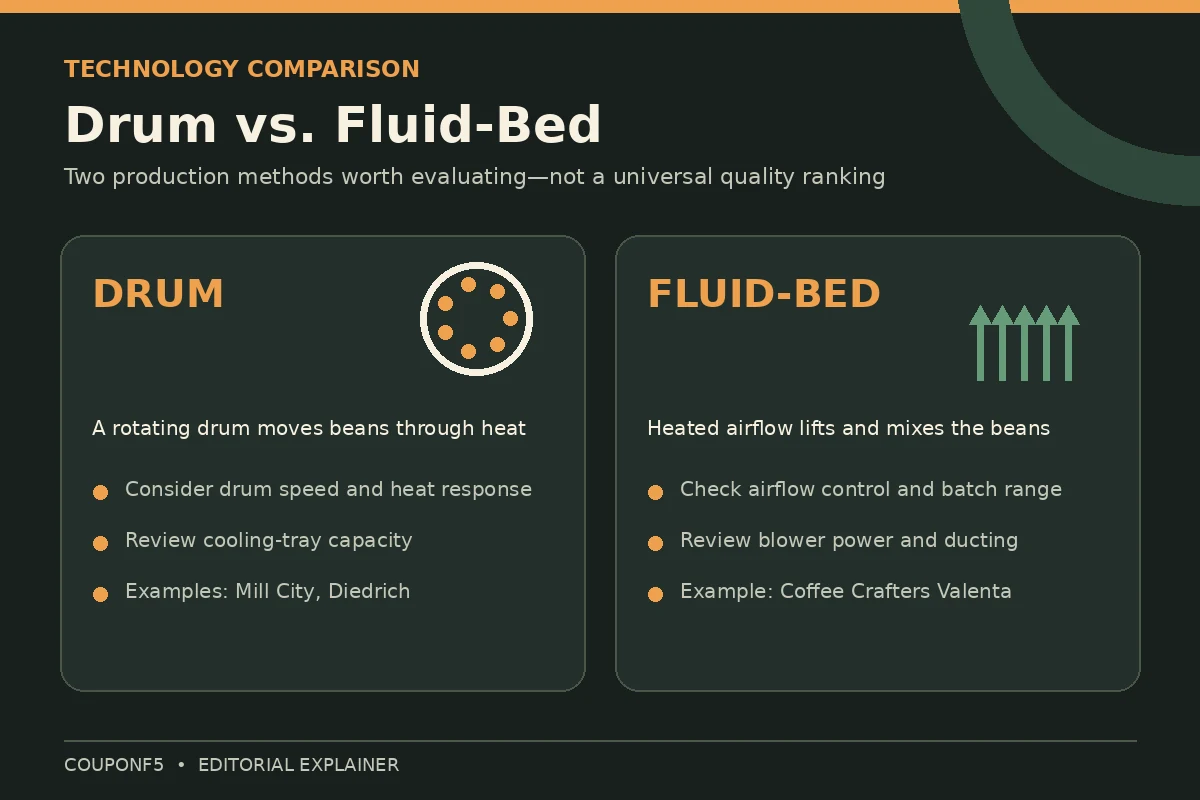
Consider a drum design if you want to work with drum-speed control, conduction/convection balance and traditional production workflow. Consider fluid-bed equipment if its airflow-driven process, available batch range and maintenance approach suit your operations. For either design, request a live demonstration at two of your typical batch sizes, then taste those roasts blind and review consistency across several batches.
4. Electric vs gas does not mean ventless vs vented
Electric heating can remove the need for a gas burner at the machine, but roasting coffee still produces smoke, odors, airborne particles and chaff. The EPA’s coffee-roasting emissions documentation identifies particulate matter and volatile compounds among roasting emissions. Electric machines therefore cannot be assumed to operate safely without approved ventilation.
The manufacturer of the Valenta equipment says its roasters require smoke to be exhausted outdoors. Mill City gives dedicated exhaust and electrical specifications for the MCR-2E. Depending on location, a local air-quality regulator, building department, fire authority or landlord may require additional review or emission controls. For example, the Olympic Region Clean Air Agency in Washington describes pre-installation approval for coffee roasters with a design capacity of 10 lb per batch or more within its jurisdiction. That is a local rule, not a nationwide exemption threshold for smaller machines.
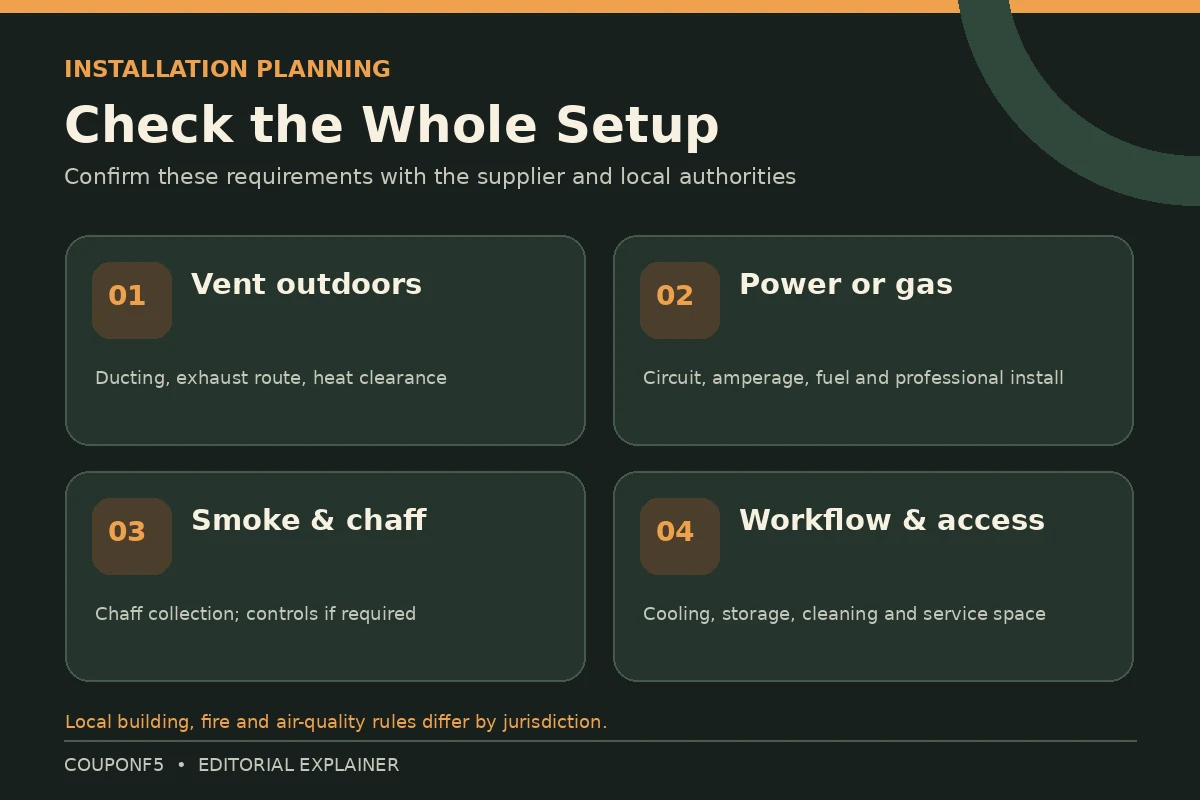
Before ordering, send the seller your intended floor plan and confirm required power/fuel, exhaust routing and clearances, chaff collection, outside make-up air where applicable, noise, deliveries, fire protection and cleaning access. Request written installation drawings and ask local authorities about the approvals that actually apply to your address.
5. Budget the entire installed roastery—not only the machine
Commercial roast equipment prices vary enormously. To show the difference in entry price, Coffee Crafters lists a Valenta 3 Base starting at $4,800, while Mill City lists the MCR-2E at $19,500 on their respective public product pages checked on November 12, 2026. These are not equivalent equipment packages and are not quotes for an operating facility. Taxes, freight, optional equipment and local installation work can change the total materially.
| Cost category | What to request before paying |
|---|---|
| Roaster and included equipment | Exact model, cooler, chaff system, controls, warranty and lead time |
| Building work | Electrician or gas fitter estimate, ducts, penetrations, permits and fire review |
| Emissions and exhaust | Fan, filtration or afterburner scope if required locally |
| Operations | Energy/fuel, green beans, operator time, maintenance, packaging and waste |
| Resilience | Parts availability, training, support response, insurance and backup production plan |
Compare cost per saleable pound: Add the monthly equipment/financing cost, facility costs, energy, labor, maintenance and planned waste, then divide by the pounds you can actually sell. If the business is still testing demand, contract roasting or shared commercial roasting space may reduce upfront capital risk. In-house roasting makes more sense when you can use the equipment regularly and operate it compliantly.
6. A practical pre-purchase checklist
- Forecast 12 months of demand. Separate recurring retail, café drinks, subscriptions and wholesale orders. Leave room for seasonal peaks.
- Calculate green-coffee input. Use your own observed roast loss when possible; do not confuse green input with roasted output.
- Request a production demonstration. Use your minimum and typical batch sizes, and ask for the realistic weekly workflow rather than only maximum throughput.
- Obtain a written facility plan. Confirm exhaust termination, electrical/gas capacity, cooling airflow and machine clearance before paying a deposit.
- Price the complete package. Include freight, installations, training, chaff management, maintenance, measuring tools, packaging and potential emissions equipment.
- Verify after-sale support. Ask who services the unit, where parts ship from and what the warranty excludes.
- Protect your launch schedule. Check lead times and approval steps, and consider backup supply if the machine is delayed or down.
FAQ: coffee roaster machines for small businesses
Is a 1 kg coffee roaster enough to start a business?
It can be enough for testing recipes, small direct-to-consumer runs and very low initial volume. However, a 1 kg green-coffee capacity does not mean 1 kg of saleable roasted coffee per batch. Calculate your weekly sales target and the number of batches, then account for labor and cooling time before deciding.
Can I run a commercial coffee roaster on a normal 120 V outlet?
Some compact models have specific 120 V versions; Aillio lists a 120 V Bullet R2 configuration. Larger production roasters often require a dedicated 230/240 V circuit or gas service. The Bullet R2 Pro specifically requires 200–240 V. Always verify the exact version’s voltage, plug and electrical installation instructions.
Do electric coffee roasters need ventilation?
Yes, roasting releases smoke, odors and particles even without a gas burner. The approved exhaust design depends on your equipment, occupancy and local rules. Never treat ‘electric’ as a promise that a roaster is ventless.
How much does a small commercial coffee roasting machine cost?
There is no single reliable price across capacity classes. As specific manufacturer-listed US examples checked on November 12, 2026, the Coffee Crafters Valenta 3 Base starts at $4,800 and the Mill City MCR-2E is listed at $19,500. Options, shipping, building work, permits and service needs can add considerably to an installed project.
Should I buy a larger machine now to allow for growth?
Only if projected demand and facility readiness justify it. A larger drum may have a minimum workable batch that exceeds your small-lot needs, and underused capacity ties up cash. Compare the machine’s usable minimum and maximum loads, your forecast, and a plausible expansion plan.
Bottom line
For a first small roastery, start by modeling how many pounds you will sell each week and validating the installation—not by choosing the largest affordable drum. Compare a compact machine such as the Aillio Bullet R2 for tiny runs, a 3 lb-class model such as Coffee Crafters Valenta 3 for entry production, a digitally controlled 2 kg system such as Mill City’s MCR-2E, or 5–6 kg equipment when demand and facilities warrant it. Shortlist suppliers that can document real batch flexibility, training, service and ventilation requirements.
Editorial methodology, November 12, 2026: We reviewed current public manufacturer product/specification pages for Aillio, Coffee Crafters, Mill City, Diedrich and PROBAT, plus EPA documentation and a regional air-quality regulator’s guidance. Price examples are published starting/list prices rather than purchase quotes. The 15% roast-loss example is an explicitly stated planning assumption. We have not purchased, operated, taste-tested or benchmarked the listed roasters, inspected a facility, or verified any location’s permits. Recheck specifications and local rules with the manufacturer and relevant authorities before ordering.
Mago Maga
Roma Pro V1.6 Home Coffee Roaster
Home green-coffee roasting appliance with adjustable roasting controls.